
Rate hike expectations now sit near 90% for Wednesday’s FOMC decision, and the last major holdout moved late Friday when Goldman Sachs withdrew its call for a hold. The reasoning it gave rested on the market reaction that would likely follow from staying on hold, with its inflation forecast left untouched. That is a justification allocators should read carefully. Core CPI printed at 2.4%, a five year low, while super core services ran 0.5% higher on the month. Bitcoin held $77,790.56 and Ether $2,523.85 into the decision, neither of them pricing distress. What follows is a tightening move whose stated purpose and whose measured justification have started to diverge.
The Read
- A 25 basis point hike is priced at roughly 90% for Wednesday.
- Core CPI at 2.4% is a five year low, yet super core services still run near 3% annually.
- KPMG models core PCE reaching 3.4% annualised, which would justify three hikes by early 2027.
Get This Analysis Summarized by AI
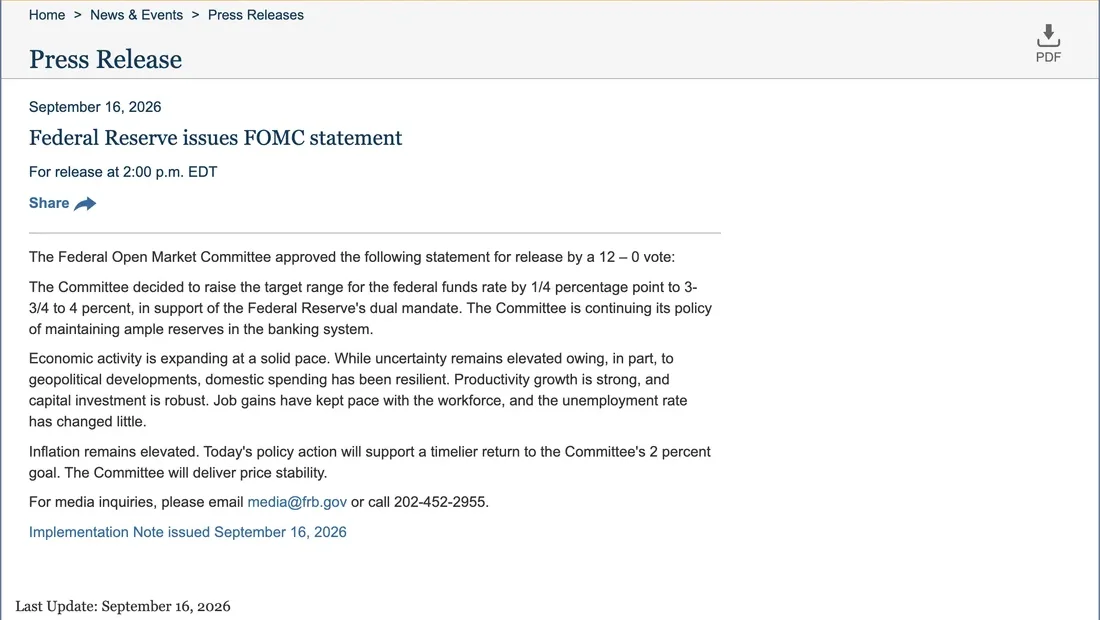
ChatGPTUpdate, September 23. The Federal Open Market Committee lifted the target range for the federal funds rate to 3.75% to 4.00% on September 16, in a 12-0 vote, and the post-meeting statement records the first increase since July 2023. Chair Kevin Warsh told the press conference that inflation had run too high for too long. Updated projections put 16 of the 18 participants behind at least one further increase before year-end, and four behind two. Anyone who read the 90% pricing as a settled outcome now faces a second question, because another hike inside the same quarter would reprice the front end again, and the crypto complex trades off that curve.

Goldman Pulls Its Hold Call Two Days Before the Vote
Goldman Sachs abandoned its call against a rate hike late Friday, leaving the street close to unanimous. The bank framed the reversal around market mechanics rather than price data, saying the aim was to avoid the reaction that would likely follow from remaining on hold.
That is a notable inversion of the usual sequence. A central bank normally moves because the data forces it, and the sell side then repositions. Here the sell side repositioned because the cost of surprising a fully priced market had become the dominant variable.
The path to this point has been unusually noisy for a single quarter. Expectations swung from a 44% implied probability after the July jobs report to something close to certainty in six weeks, without a single inflation release that moved the trend decisively in either direction.
James Thorne, chief market strategist at Wellington-Altus, argued the tightening is aimed at calming Wall Street rather than at inflation, and leaned on wage growth of 3.1% year over year with no demonstrated wage price spiral to make the point. Diane Swonk, chief economist at KPMG, pushed back, estimating the PCE index rose 0.4% in August.
Also on CFinance:
- Trump Dividend Puts $1.2 Trillion on the Table
- Zcash ETF Tops $500M With $100M From a DCG Affiliate
- Oil Shock at $92.89 Tests Crypto ETF Inflows Before CPI
The Rate Hike Case Splits Core CPI From Super Core Services
The two readings that matter here disagree. Headline core CPI came in at 2.4%, its lowest in five years, which on its own argues for patience. Super core services, which strips goods and shelter to isolate the stickiest part of the basket, rose 0.5% on the month and roughly 3% on the year.
Swonk’s model turns that split into a forecast. An August PCE at 0.4% puts core PCE at 3.4% annualised, well clear of the 2% target, and from there she expects three rate hikes by early 2027 rather than one and done.
Now the reason this matters beyond rates desks. A single rate hike into a fully priced market is a non event for crypto allocation. A path of three reprices the discount rate on every long duration risk asset, and the 9-3 split on the board at the July hold shows the committee itself has no settled view on which of the two it is delivering.
The CPI print is also a poor standalone trigger for positioning. A cool reading on its own has not justified adding crypto risk in any of this year’s episodes, because the flows have consistently keyed off the rate path rather than the monthly number.
Why a Decision Either Way Clears the Air for Allocators
A mechanical argument carries the bull case here. A rate hike that is 90% priced removes the event risk that has kept mandates on the sidelines since late August, and an unwound uncertainty premium frees capital regardless of the direction of the move itself.
Spot levels support that reading. Bitcoin at $77,790.56 and Ether at $2,523.85 going into a near certain tightening is not a market pricing stress, which suggests the rate hike is already absorbed and the reaction function now sits on the statement language instead.
If Thorne’s framing holds and the move is about market management rather than a deteriorating inflation picture, the terminal rate stops rising after Wednesday. That is the single variable institutional crypto allocation has been waiting on, and a one and done outcome would settle it in the direction flows need.
The Path Where Three Hikes Drain Crypto Beta
The bear case runs through Swonk’s number. If core PCE is genuinely tracking 3.4% against a 2% target, Wednesday is the first of three, and a rising terminal rate compresses every valuation built on duration. Crypto sits at the far end of that curve.
Flow evidence already leans that way. Crypto ETF inflows were being tested by an oil shock at $92.89 before this print, and a tightening cycle stacked on an energy shock is the combination that has reliably turned allocator interest into redemptions.
Pricing the asymmetry means looking past the rate hike itself. It is the statement. A 25 basis point move with language that leaves the door open to two more is the outcome the current spot levels are least prepared for, and the gap between a priced hike and an unpriced path is where the repricing would land.
More to come.
About the Author