

The Trump administration is weighing joint ventures with private issuers to push dollar stablecoins into foreign markets, an effort that would pull the Treasury Department, the State Department and the US International Development Finance Corporation into the same programme. The stated aim is to defend the dollar’s reserve status and deepen demand for Treasury securities at a moment when issuance keeps climbing. Stablecoin issuers already hold close to $200 billion of US government debt, which places them inside the top twenty holders of sovereign paper worldwide. The whole market sits at $292.49 billion, with two tokens accounting for roughly 90% of it. Nothing has been formally announced, the reporting rests on unnamed sources, and partner firms, target countries and timetable all remain open. For an allocator, what matters is what a state-backed distribution channel would do to the credit profile of instruments that are currently private liabilities.
The Read
- Treasury, State and the DFC would partner with private issuers to spread dollar stablecoins abroad.
- Issuers of dollar stablecoins hold about $200 billion in Treasuries, ranking them among the top twenty sovereign debt holders.
- The IMF warns the same mechanism accelerates capital flight in emerging markets.
Get This Analysis Summarized by AI
ChatGPTWhat Washington Is Considering for Dollar Stablecoins
That plan would have the US government take equity alongside private issuers of dollar stablecoins, using joint ventures as the vehicle for overseas distribution. Bloomberg reported the outline, citing people familiar with the discussions, and no agency has confirmed it on the record.
Its agency mix is the part worth reading closely. The DFC is a development finance institution, built to deploy capital in emerging economies, and its presence signals that the target markets are exactly the ones where local currencies compete poorly against the dollar.
This policy framing is not new inside the administration. David Sacks, the White House crypto and AI czar, argued in February 2025 that stablecoins could extend the dollar’s dominance internationally and generate trillions in fresh demand for US government debt.
Treasury Secretary Scott Bessent made the same case in July 2025 around the GENIUS Act, the framework that cleared US banks to issue stablecoins once the FDIC signed off, describing it as a way to reinforce reserve status while lifting Treasury demand. The dollar already clears close to 90% of global foreign exchange transactions, so the marginal gain being chased here is narrower than the rhetoric suggests.
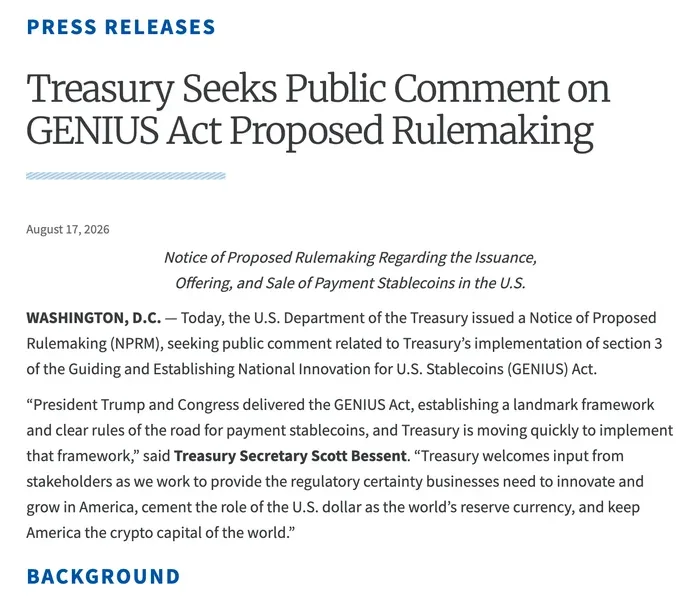
The legislative groundwork is in place. The GENIUS Act built the federal framework for payment stablecoins, and the Treasury opened a public comment period on its proposed rulemaking for stablecoin issuance, offer and sale on August 17, 2026, which supplies the regulatory scaffolding any joint venture would sit on.

How the Treasury Demand Mechanism Actually Works
That chain runs short. A foreign user buys one of these dollar stablecoins, the issuer receives dollars, and the issuer parks those dollars in short-dated Treasuries to back the peg. Every unit of offshore adoption converts into a bid at the front end of the curve.
Scale here is already meaningful. Issuer reserves hold roughly $200 billion in US debt against a total stablecoin market of $292.49 billion, and that concentration puts the sector ahead of most national central banks in the league table of Treasury holders.
Concentration cuts in a specific direction here. Tether and Circle together account for about 90% of all dollar stablecoins in circulation, which means a sovereign-backed distribution push would mostly enlarge two private balance sheets rather than build a diversified channel. That concentration sits among the four stablecoin risks the market keeps ignoring.
The state has been building the plumbing for this for a while. Institutional reserve vehicles arrived first, including the moment State Street launched the SSCXX stablecoin reserve fund, and the banking channel opened once federal regulators cleared deposit-taking institutions to issue their own tokens.
Competing systems explain the urgency. China’s digital yuan moves cross-border through Project mBridge, and the European Central Bank has scheduled a twelve-month digital euro pilot starting in mid-2027, both of them state-run rails rather than private tokens.
Also on CFinance:
- Kalshi Perpetual Volume Rests on a Single Market Maker
- Circle Opens USDC Borrowing Against Bitcoin to Institutions
- Saylor’s Strategy Resumes Buying With 950 Bitcoin
The Case for a Structural Bid on Short-Dated Paper
The bull argument starts with sizing. Payment volume running through these rails is already large, as the market showed when stablecoins hit $270B in supply against $30 trillion in annual volume, and a state-supported channel would push that base higher.
A larger float of dollar stablecoins mechanically deepens the bid for bills. Treasury issuance keeps growing, and a buyer whose demand scales with adoption rather than with rate expectations is structurally useful to a debt manager planning auctions.
Government participation would also compress the regulatory discount attached to the sector. An issuer sitting in a joint venture with the DFC carries a different counterparty profile from one operating offshore, and compliance teams price that difference when they set exposure limits.
For a treasurer running cross-border settlement, the practical gain is operational. Dollar stablecoins already settle faster and cheaper than correspondent banking in the corridors the DFC targets, and official backing removes the reputational objection that has kept many corporates from using them at size.
Where a Sovereign-Backed Stablecoin Push Breaks
The International Monetary Fund has already flagged the core problem. Wider adoption of dollar stablecoins in emerging economies accelerates capital flight, weakens domestic currencies and strips local policymakers of control over financial flows, which turns the programme into an export of monetary instability.
A separate warning comes from the Bank for International Settlements, arguing in its 2026 annual report chapter on anchoring trust in money that stablecoins fall short on singleness, elasticity and integrity. Two multilateral institutions warning about the same instrument is a durable political obstacle, and it gives target governments a ready argument for restricting distribution.
Reflexivity runs the other way too. A reserve pool concentrated in short-dated Treasuries has to be liquidated when redemptions spike, so the same mechanism that supplies a structural bid becomes a forced seller into a stressed bill market.
Political exposure compounds it. A joint venture between federal agencies and private issuers puts taxpayer capital behind instruments whose largest operator has spent a decade fielding questions about reserve composition, and that pairing invites congressional scrutiny well before any launch.
The asymmetry for an allocator sits in the gap between reporting and reality. Confirmation of the programme changes little in the near term, because no partners, countries, amounts or timetable exist yet. A formal launch, or a public rejection by a major emerging-market government, would reprice the regulatory assumptions underneath every dollar stablecoin position at once.
More to come.
About the Author