
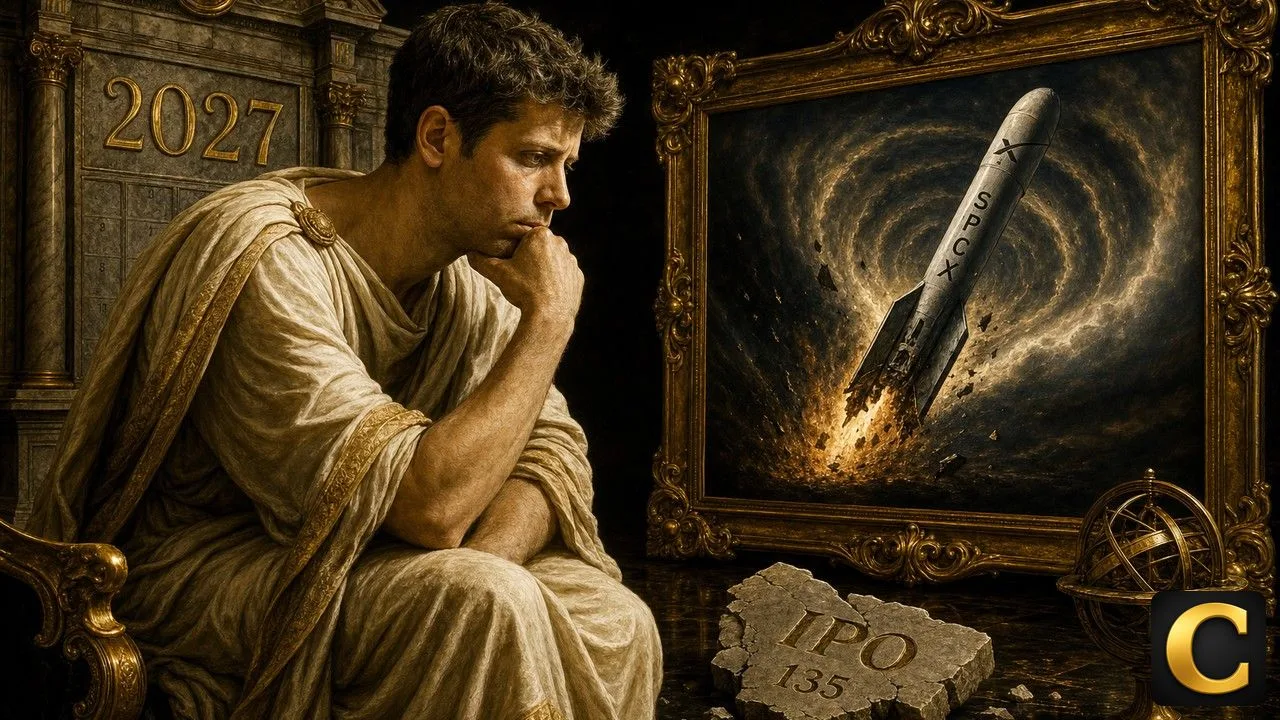
OpenAI is reportedly leaning toward pushing its initial public offering into 2027 rather than going public later this year. Sam Altman’s company is reacting to the post-IPO collapse of Elon Musk’s SpaceX (SPCX), which has shed 16.5% in ten days and now trades at $154.60. The episode reshapes how late-stage tech is approaching public markets.
Key Takeaways
- OpenAI IPO is reportedly delayed to 2027 over market conditions.
- SpaceX dropped 16.5% to $154.60 just ten days after pricing at $135.
- Cerebras (CBRS) sits at $221, down nearly 50% from its post-IPO peak of $343.
OpenAI IPO Hits the Brakes
The OpenAI IPO calendar is shifting. The full picture is available in OpenAI’s confidential S-1 submission announcement.According to multiple reports, Sam Altman’s company is leaning toward postponing its public market debut until 2027, rather than rushing a listing in the current environment.The decision is not yet final, but the conversation inside the company has clearly tilted toward patience.
The drivers cited by executives center on two factors: the post-IPO performance of SpaceX, which has been brutal, and the general choppiness of broader markets. The combination raises the risk of a botched debut, with the kind of headline damage that can take years to repair for a brand as visible as OpenAI.
A 2027 listing also gives OpenAI time to keep growing into its valuation. Private secondary trades have repeatedly pushed its implied price above what some bankers consider sustainable for a public float, and any disappointing print in the first weeks of trading would expose the company to a SpaceX-style derating.
The macro context plays a role too. The Fed under Kevin Warsh has signaled a hawkish bias, and ETF outflows have stretched into a sixth consecutive week. Going public into a market that is repricing risk lower is a recipe for an underwhelming reception.

The SpaceX Cautionary Tale
SpaceX’s stock journey since its mid-June listing has been a textbook lesson in how mega-IPOs can sour. The stock priced at $135, surged more than 40% on its debut, briefly handed Elon Musk’s company a $2.6 trillion valuation, then began a steady retreat. By the close ten days after listing, SPCX traded at $154.60, down 16.5% from its early peak.
The slide accelerated into the close on multiple sessions, with sellers refusing to absorb the supply hitting the tape. Lock-up dynamics, profit-taking from early backers, and a general rotation out of speculative growth names all contributed. The stock now sits near its lowest level since opening trades.
The damage extends beyond SpaceX itself. The post-IPO performance has become a reference case for late-stage CEOs and their bankers, and it is shaping discussions across the upcoming tech IPO pipeline. Companies that were targeting an autumn debut are reportedly reconsidering timelines.
For OpenAI specifically, the parallels are uncomfortable. Both companies share a high-profile founder, an aura of inevitability, and a valuation that has compounded fast in private markets. The lesson Sam Altman appears to be drawing is that a hyped IPO with a punishing follow-through can erase years of brand equity in weeks.
Cerebras and the AI IPO Wake-Up Call
Cerebras Systems (CBRS) tells a similar story on a smaller scale. The AI chipmaker priced at $185 in May, surged to $343 on day one, then slid almost 50% to around $221. The drawdown happened in a market that was supposedly tailored for AI exposure, with Micron, Nvidia and other chip names rallying on the strength of data center demand.
The Cerebras experience matters because it shows that even AI-direct exposure does not insulate a stock from post-IPO gravity. Investors who bought the IPO are still up materially, but those who chased the open are down meaningfully. That dynamic has become a recurring pattern.
The pipeline behind OpenAI is crowded. Anthropic has also filed to go public. The structural risk for the broader sector is that a sequence of weak debuts hardens the discount that public markets apply to private tech valuations, which then feeds back into the secondary marks used for fundraising rounds.
Some institutional players are already drawing the parallel with crypto-adjacent equities. Strategy’s STRC preferred dropped to $83 in the same liquidity rotation, with capital exiting both crypto-treasury vehicles and freshly listed AI plays. The rotation is reshaping which stories command a premium in 2026.
A 2027 OpenAI IPO would leave the public AI playbook in the hands of Cerebras and a handful of smaller plays for another twelve to eighteen months. That is a long time in a market where AI infrastructure narratives have driven a meaningful share of overall equity gains.
Follow the story on Cfinance.
About the Author