Jeremy Grantham, the GMO co-founder and one of the most quoted bears in modern finance, is calling what he sees today the largest financial bubble in U.S. history. He projects corrections of up to 70% for AI-linked tech valuations and tells investors to leave U.S. equities entirely. He also dismisses Bitcoin as useless nonsense and predicts it will eventually go to zero. His allocation grid leans on international stocks, government bonds, real estate and precious metals.
Key Takeaways
- Grantham calls today’s market the largest financial bubble in U.S. history
- He sees AI tech valuations possibly correcting up to 70% from current levels
- He dismisses Bitcoin as useless and recommends international stocks, bonds, gold and silver
The AI Bubble Call
Grantham’s central claim is direct. The full picture is available in Grantham’s GMO viewpoint on the AI bubble.He describes the current market as the largest financial bubble in U.S.history, larger than the dot-com peak and larger than the run that preceded the 1929 crash.The center of the bubble, in his reading, is the cluster of AI-linked tech stocks that has driven index returns over the past eighteen months.
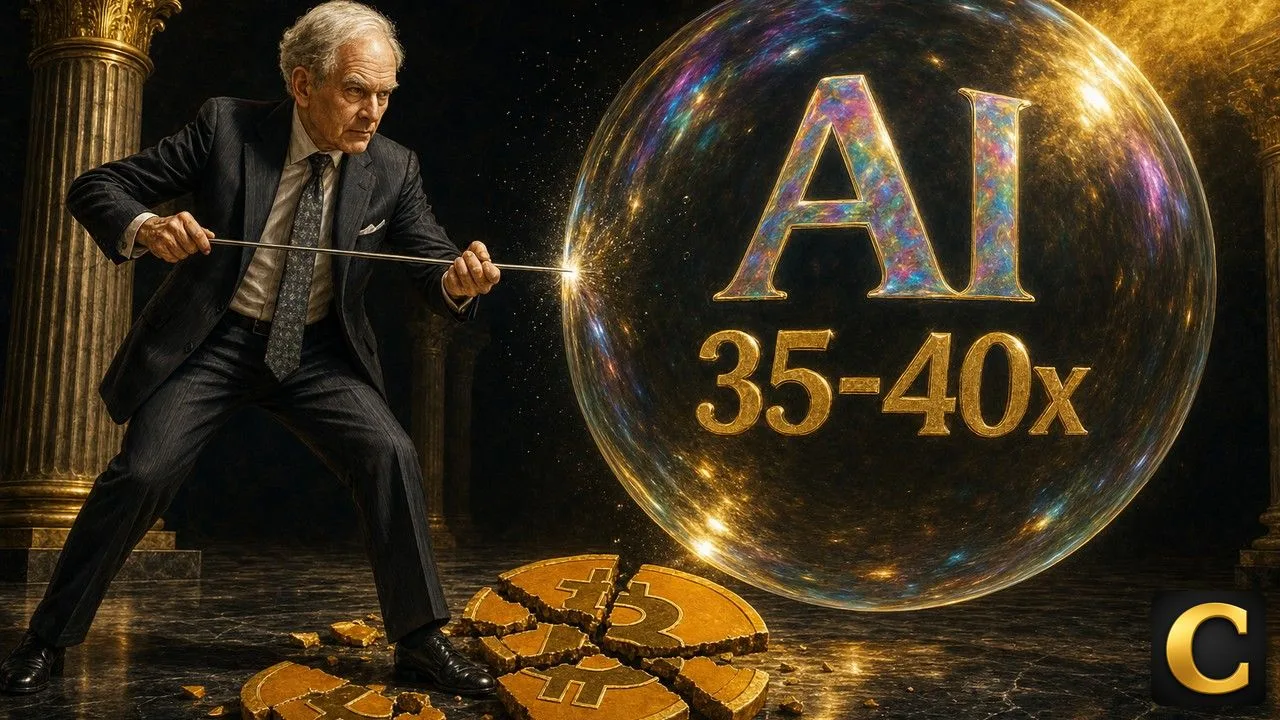
The valuation evidence he cites is concrete. U.S. equity markets trade at 35 to 40 times earnings, well above historical norms for sustained periods. At those multiples, the embedded growth expectations imply earnings paths that even the strongest AI operators may struggle to deliver.
His historical reference is Amazon in 1999. The stock surged into the tech peak and then fell 92% from its 1999 high before eventually recovering over many years. Grantham uses this case to point out that even the eventual winners go through brutal drawdowns when the bubble unwinds. Owning the right company is not enough if the entry point sits in the bubble.
He singles out SpaceX as a textbook bubble narrative. Market commentary around the company projects asteroid mining revenues and contributions of up to a quarter of global GDP. For Grantham, these stories echo the South Sea Bubble of 1720, when investors funded ventures whose business model was, in some cases, kept deliberately vague. The lesson is that valuation logic breaks down when the underlying claim becomes unfalsifiable.
The rotation already showing up in crypto markets fits this framing. The week Micron jumped 13% as the AI trade pulled cash from crypto illustrates how concentrated the bid has become around a small set of names. Grantham’s point is that this concentration, more than the AI thesis itself, is what sets up the eventual reset.

Bitcoin in the Crosshairs
Grantham holds no cryptocurrency. He explains the position in plain terms. He calls Bitcoin useless nonsense and says it does not facilitate any economic activity except for criminals. The framing is harsh by design, and it reflects his discomfort with assets whose value rests primarily on narrative.
He points to the volatility of the past twelve months as supporting evidence. Bitcoin dropped from around $120,000 to roughly $60,000 over that period. For Grantham, an asset with that kind of swing cannot reasonably function as either a store of value or a daily medium of exchange.
His functional critique is more interesting than the moral one. Bitcoin’s failure as a daily currency is not theoretical. The argument that you cannot easily walk into a store and pay with it remains true at scale, despite the rails built around the asset over the past decade. The case of the institutional treasuries that hold BTC does not change that observation.
Grantham concludes that Bitcoin will eventually go to zero, though he refuses to set a timeline. The forecast is provocative, and it likely overshoots what most market observers would project. The forecast serves a function in his framework anyway. It anchors the rejection of Bitcoin as a non-negotiable line in an allocation that he wants to keep concentrated on assets producing actual income.
For the broader crypto sector, the message is more nuanced than the headline suggests. Grantham’s critique applies most directly to Bitcoin as a store-of-value claim. It says less about utility-driven protocols or tokenized real assets, which sit in a different category and have a different test for validation.
Where He Tells Investors to Go
Grantham’s allocation grid is unusual by U.S. standards. He advises investors to avoid U.S. equities entirely at current multiples. The recommendation is not subtle. It applies to indices, more than just to AI tech names, because the concentration risk of the S&P 500 makes the whole basket vulnerable to the AI unwind.
In place of U.S. exposure, he points to 60% in international stock indices, with explicit allocations to Europe, Japan and emerging markets. These markets trade at lower multiples than the U.S. and have been ignored by capital flows for years. Grantham believes the gap will narrow when U.S. valuations correct.
The remaining sleeves include government bonds, real estate and precious metals. Gold and silver appear explicitly in the recommendation. The logic is defensive. These assets typically hold value during corrections, and they offer hedges against the inflationary scenarios that he does not rule out for the coming years.
The allocation reads as a vintage value-investor playbook. There is no positioning on AI rotation winners, no hedge fund overlay, no crypto sleeve. The thesis is that surviving the bubble unwind matters more than catching the last leg up. Whether retail investors can stomach that posture is a separate question.
For the next twelve months, the gap between Grantham’s call and the market’s behavior will define the credibility of his framework. If AI tech valuations hold or extend, the international rotation thesis loses its appeal. If they crack as he predicts, his grid becomes one of the very few public allocations that prepared for the move.
More to come.
About the Author