
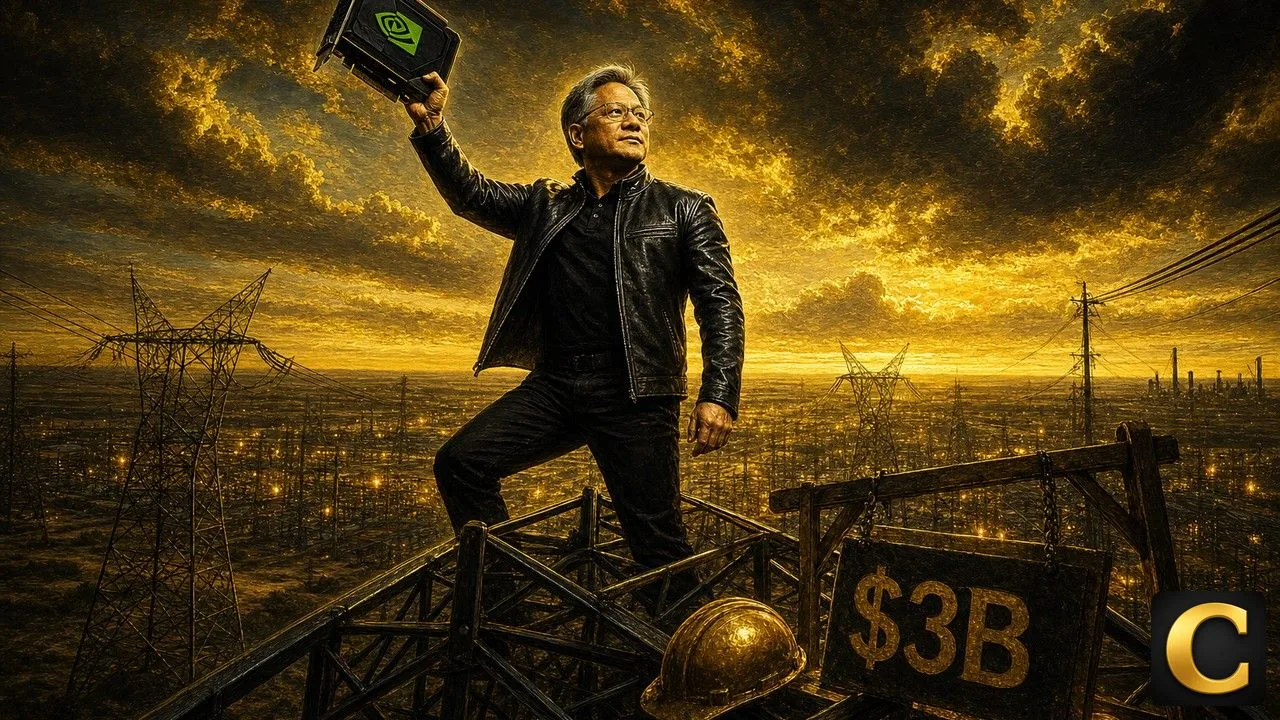
Nvidia is taking an equity position in Lancium, the Blackstone-backed developer that owns the Texas campus hosting the first operational Stargate site. The structure runs in two steps: $2 billion now for roughly 20% of the company, then a further $1 billion tied to milestones that include grid hookups, which would lift the stake toward 30%. The deal marks the enterprise value of Lancium at around $10 billion, a number built far more on interconnection rights than on installed hardware. What makes this different from Nvidia’s previous financing moves is that the chipmaker is no longer underwriting its customers, it is buying the electricity layer underneath them. Lancium has 4 gigawatts locked and developed on the Texas grid, with another 15 gigawatts still waiting for connection. Investors have to decide whether that pipeline is an option or a queue position dressed up as an asset.
The Read
- Nvidia commits $2B for about 20% of Lancium, with $1B more tied to grid milestones.
- Lancium is marked at roughly $10B enterprise value, backed by 4 GW live and 15 GW pending.
- The check is pure equity, with no credit guarantees on data center construction or leases.
The Chipmaker Moves Down to the Electricity Layer
Lancium owns the 1,000-acre Clean Campus in Abilene, Texas, the first operational site of the Stargate joint venture between SoftBank, OpenAI and Oracle. That project was unveiled in January with a headline figure of up to $500 billion in AI spending. Nvidia is buying into the entity controlling the power feeding its first physical footprint.
The initial tranche is $2 billion for roughly a 20% stake, with a further $1 billion contingent on Lancium hitting defined thresholds, grid hookups among them. Clear that bar and Nvidia’s ownership moves to around 30%. The conditional half of the check is the interesting part, because it prices execution risk rather than assuming it away.
Nvidia has spent two years supporting demand for its own hardware through vendor financing and credit substitution. Owning equity in a power developer is a different instrument, a bet on the constraint itself, and it sits alongside a capital plan that already runs into the trillions, as the projected $3.4T of AI infrastructure spending through 2030 makes clear.

Equity Without Guarantees Changes the Risk Split
The check is structured as an equity stake and carries no credit guarantees for data center construction or for the leases signed on those buildings. That keeps the exposure off Nvidia’s contingent liabilities, but it also leaves the chipmaker holding the most junior claim in the capital stack if the buildout runs long.
Now consider what the $10 billion enterprise value is actually marking. Lancium has 4 GW locked and developed against 15 GW still pending connection, so close to four fifths of the portfolio is a claim on future interconnection rather than delivered capacity. Bulls will argue that queue position in Texas is the scarcest asset in the AI buildout. Bears will note that a queue is not a contract, and that regulators, not developers, set the pace.
The capital is expected to fund expansion ahead of a possible Lancium listing in 2027. That hands Nvidia an exit path and a mark-to-market event, while tying the value of the stake to whatever the IPO window looks like in eighteen months. Nvidia’s valuation has been the swing factor across the semiconductor complex all year, a pattern visible in how Samsung and DeepSeek headlines moved Nvidia, Micron and AMD together.
The 15 GW Pipeline Is Where the Upside Sits
If even a third of the pending 15 GW gets energized on schedule, the $10 billion mark looks conservative against what hyperscalers pay for secured power. Compute has stopped being the binding constraint and electricity now sets the ceiling on the buildout, which hands pricing power to whoever holds usable interconnection.
There is a second layer to the bull case. Buying the power supplier to Stargate creates a structural preference for Nvidia accelerators inside those halls, without any contract saying so, and captures margin twice on the same watt. Nvidia’s scale makes that credible in a way rivals cannot replicate, which is part of why the race for the largest market cap keeps coming back to Nvidia.
The conditional tranche also works in shareholders’ favour. Nvidia pays the second $1 billion only against delivered milestones, so that downside is capped by performance rather than by hope. It is a cleaner structure than the vendor financing drawing scrutiny elsewhere in the AI complex.
What Breaks If the Grid Queue Slips
The bear case starts with timing. Interconnection queues in Texas move on regulatory calendars, not on capital availability, and a two-year slip on the 15 GW pipeline would leave Nvidia holding a minority stake in an asset marked well above what its live 4 GW supports on its own.
The 2027 listing is the second pressure point. A Lancium IPO into a cooling market would print a valuation below the $10 billion enterprise value struck here, and that public mark feeds straight back into how investors value Nvidia’s growing web of related-party positions.
One thing to notice is the asymmetry investors are being asked to price. The upside runs through gigawatts regulators have not yet approved, the downside through an equity stake with no contractual floor. Nvidia can absorb $3 billion without strain, so the real question is whether owning the grid layer strengthens the AI trade or concentrates more of it on one balance sheet.
More to come.
About the Author