
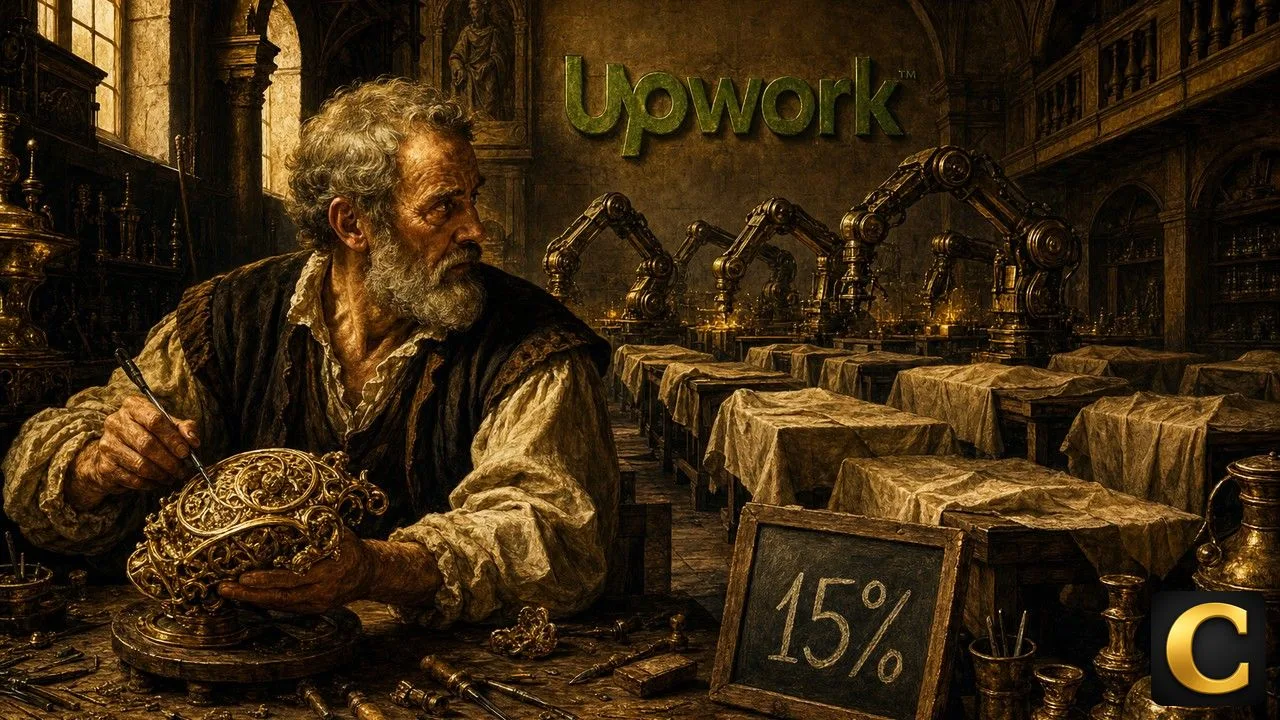
Upwork delivered a quarter that beat its own targets and still lost 15% on Tuesday. Second-quarter revenue came in at $191.7 million, at the high end of guidance, and adjusted EBITDA of $64.1 million exceeded the company’s outlook. The market ignored all of it and traded the other number instead: a full-year 2026 revenue forecast lowered to $730 million to $750 million. Management pinned the cut on worsening Google search referrals, a soft labor market and a faster pace of AI automation eating into lower-complexity work. The same AI shows up on the other side of the ledger, with AI-related work now running at roughly $330 million annualized. That tension between AI as a demand killer and AI as the growth engine is the whole investment case now.
The Read
- Q2 revenue of $191.7M hit the high end of guidance and adjusted EBITDA of $64.1M beat the outlook, yet the stock fell 15%.
- Full-year 2026 guidance was cut to $730M-$750M in revenue on weaker Google referrals, a soft labor market and faster AI automation.
- AI-related work is the counterweight, growing to a ~$330M annualized run rate with AI consulting up 51% year over year.
A Beat on Both Lines That the Market Refused to Pay For
The quarter itself was clean. Revenue printed at $191.7 million, the high end of guidance, gross services volume reached $966 million, and GAAP net income came in at $25.4 million. Adjusted EBITDA of $64.1 million landed above the company’s own outlook, at a 33.4% margin.
The sell-off came from the forward numbers. Upwork now guides 2026 revenue to $730 million to $750 million with adjusted EBITDA of $225 million to $235 million and non-GAAP diluted EPS of $1.38 to $1.43. Third-quarter guidance of $176 million to $184 million implies a sequential step down from the $191.7 million just reported, with Q3 EBITDA guided to $50 million to $54 million. The company detailed the full reset in its second-quarter results release published Monday.
The client base tells the same story from another angle. Active clients stand at 763,000 with weaker acquisition trends, while GSV per active client hit a record $5,230, up 5% year over year and an eighth consecutive quarter of sequential growth. Chief executive Hayden Brown framed the strategy as prioritizing customer value and higher-value work rather than client volume. Fewer, richer accounts is now the operating model, backed by a 19.8% take rate.

Three Headwinds Behind the Guidance Reset
A beat that gets sold this hard is a message about trust in the trajectory, not the quarter. Investors saw the same pattern days earlier when Datadog dropped 19% after beating and raising. In both cases the print was fine and the multiple was not.
Upwork named its problems plainly. Google search referrals are deteriorating, the labor market is not improving, and AI automation is compressing demand for lower-complexity tasks. The guidance explicitly assumes no labor-market recovery and a heightened pace of automation through year-end.
The Bull Case Runs Through the $330M AI Book
The upside scenario is that the Upwork AI line grows faster than the low-end work disappears. AI job GSV rose 22% year over year, the AI strategy and consulting category grew 51%, and AI-related work runs at roughly $330 million annualized. Business Plus, the SMB offering, grew GSV 174% year over year with active clients up 219%, and the enterprise EOR offering added 29%. The higher-value cohorts are compounding while the commodity end erodes.
Margins buy time for that mix shift. A 77% non-GAAP gross margin, a 33.4% EBITDA margin and $35.9 million of quarterly free cash flow mean the model funds its own transition. Corporate demand for AI skills is not speculative either, as the AI spending running through big tech earnings keeps translating into consulting and integration work that lands on platforms like this one. If the higher-value pivot holds, the guided $225 million to $235 million of EBITDA puts the stock on a cash-generative floor while the narrative resets.
The Bear Case Is a Funnel That Narrows Faster Than the Mix Improves
The downside scenario is structural. If AI keeps automating the low-complexity tasks that once fed the top of the funnel, and Google referrals keep fading as search behavior moves into chatbots, then client acquisition gets more expensive exactly when the addressable pool of simple gigs shrinks. Value per client has a ceiling as a growth engine when the client count itself is trending down.
The labor displacement is not hypothetical. The largest employers are reorganizing white-collar work around AI head-on, with Microsoft budgeting $2.5B for 6,000 AI engineers while trimming elsewhere. The asymmetry into the next Upwork print is unforgiving: the Q3 guide already embeds the step down, so another cut would confirm the funnel is eroding faster than the AI book compounds, and the 15% repricing would look like a first installment rather than a floor.
More to come.
About the Author