
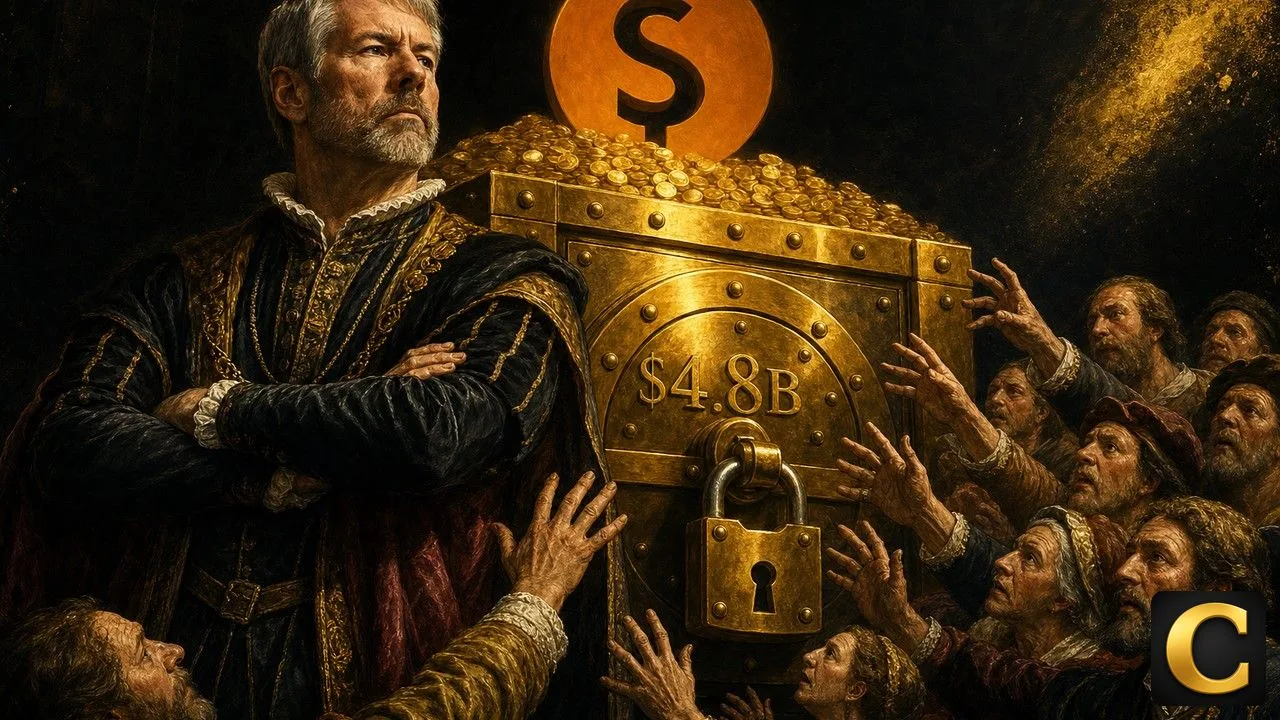
Michael Saylor spent part of his Monday Q&A session at Consensus 2026 in Miami answering the question every battered MSTR holder wanted asked: with the stock down roughly 38% this year, why is Strategy not buying back its own shares? The executive chairman’s answer was a hierarchy, and common stock repurchases sit at the bottom of it. The company’s priorities run through its STRC preferred stock, a cash reserve that has now grown to $4.8 billion, and its emerging credit business. Saylor left one door open, saying a buyback becomes plausible if MSTR trades at a very deep discount to net asset value. The stock closed the session around $96.98, up about 5% on the day, while bitcoin traded at $64,254.02. This piece walks through what was said, how the cash machine actually works, what could flip the company into buyer mode, and why the patience Saylor is asking for has become the trade’s real cost.
The Read
- Saylor said Monday at Consensus 2026 that share buybacks are not a priority; STRC, the $4.8B cash reserve and the credit business come first.
- A repurchase becomes an option only if MSTR trades at a very deep discount to NAV; the stock sits at $96.98, down 38% YTD and 73% over one year.
- Saylor told holders to think in four-year minimum horizons, ideally seven to ten, and confirmed Strategy can sell bitcoin as well as buy it.
Saylor Draws a Hierarchy and Buybacks Land Last
The setting was a question and answer session in Miami, and the answers were unusually direct. Asked about repurchasing common stock, Saylor put it plainly: if MSTR trades at a very, very deep discount to NAV, then investors would probably see the company do something like that. Anything short of that threshold keeps the buyback on the shelf.
The market context explains the pressure behind the question. MSTR is down 38% year-to-date and 73% over twelve months, a drawdown that has already forced the company to defend its preferred shares when STRC slid to $83, well below its $100 par. The bull read is that management refuses to burn dry powder propping up the common stock. The bear read is that management just told you the common stock is on its own.
Monday’s tape leaned toward the bulls. Shares gained about 5% to $96.98 during a session in which bitcoin held near $64,254.02, a sign that clarity about capital priorities was worth something even to holders who wanted a different answer.

Inside the $4.8B Reserve: Dividends First, Credit Next
The cash pile is not idle money. Strategy maintains the reserve largely to cover the dividend obligations attached to its preferred stock program, the same mechanism that reset the STRC payout at the end of June. Saylor framed the reserve as the foundation the rest of the structure stands on: dividends get paid first, and everything else queues behind them.
The credit business is the newer branch of the same tree. Saylor placed it explicitly ahead of buybacks in the queue, which tells investors where the next dollars of balance-sheet capacity are headed. The bull read is diversification of the revenue base beyond a single leveraged bitcoin bet. The bear read is that a company whose stock is down by double digits is choosing to fund a build-out instead of its own shareholders.
CEO Phong Le handled the other side of the capital equation. He defended issuing new MSTR shares when they trade above asset value, arguing the proceeds let the company buy bitcoin while increasing the bitcoin backing per share. The logic is accretion for existing holders. The tension is that issuance above NAV and repurchases below NAV are mirror images, and only one of them is currently being executed.
The reserve question has a history. Doubts about the company’s liquidity fueled a wave of analysis when CryptoQuant questioned whether the cash position could halt the flywheel. A reserve at $4.8 billion is the company’s rebuttal, and Saylor made sure the number was heard.
One thing to notice is what Saylor added about the other direction. The company has to be able to sell bitcoin as well as buy it, he conceded, a flexibility Strategy already exercised when it sold coins for the first time since 2022. Optionality cuts both ways, and holders now know the treasury is not a one-way vault.
The Discount Trigger That Could Flip Strategy Into Buyer Mode
The bull case starts with the door Saylor left open. He did not rule buybacks out; he priced them. A very deep discount to NAV is now a stated trigger, backed by $4.8 billion of available liquidity, and markets tend to front-run stated triggers. The deeper the discount gets, the closer the company moves to becoming the marginal buyer of its own equity.
The second leg is mechanical. If the company issues stock above NAV to buy bitcoin and repurchases stock below NAV, both operations increase bitcoin per share. That symmetry is what Phong Le’s defense of issuance implies, even if only half of it is active today. For a holder, the framework itself is the asset: capital allocation with explicit rules on both sides of NAV is rarer than it sounds in this sector.
Monday’s price action supplied the early evidence. A 5% bounce on a day when the answer was essentially “no buyback for now” suggests the market rewards the clarity more than it resents the refusal. If bitcoin stabilizes above $64,000, the setup gives systematic buyers a reason to re-engage before any repurchase is ever announced.
Down 73% in a Year, Patience Becomes the Real Price
The bear case begins with the horizon Saylor is asking for. He told investors to be prepared for difficult years, recommending a four-year minimum holding period, ideally seven to ten. He acknowledged the pain directly. That is an honest framing, and it is also a warning: nothing in the plan is designed to rescue the share price on a shorter clock.
The dividend machine is the second pressure point. The reserve exists first to service preferred payouts, which means the cash cushion shrinks on a schedule regardless of where MSTR trades. A stock down 73% over one year with its buyback explicitly deprioritized leaves the common shareholder last in the capital queue, behind STRC holders and the credit build-out.
The other side of this is what the refusal signals about internal NAV math. If management believed the stock were already trading at the very deep discount Saylor described, the buyback would presumably be live. It is not, which means the people with the best view of the balance sheet do not yet see $96.98 as the bargain the drawdown chart suggests. Holders buying here are taking the other side of that read.
The final risk is the sentence holders will reread later. A treasury that can sell bitcoin as well as buy it is prudent management in a drawdown, and it is also a standing overhang in a panic. If the discount to NAV widens while bitcoin weakens, the same flexibility that reassures today becomes the asymmetry the market prices in first.
More to come.
About the Author