

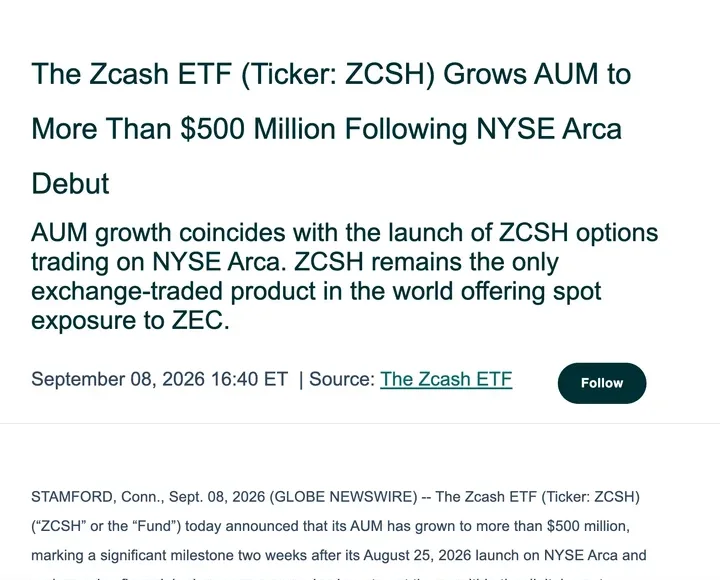
Grayscale said its Zcash ETF crossed $500 million in assets barely two weeks after listing, a headline number that reads like one of the fastest ramps in recent product history. The fund, trading as ZCSH, now holds more than 550,000 ZEC, roughly 3% of the token’s 16.9 million circulating supply pulled out of float in a fortnight. What the announcement also discloses is that $100 million of that total came from DCG International Investments Ltd., a wholly owned subsidiary of the sponsor’s own parent, contributed in kind through an authorized participant. Genuine third-party inflows ran a little over $70 million across the same period. ZEC traded above $1,200 that week, peaking near $1,249, its highest level since late 2016. The gap between the headline and the outside demand is the whole story for an allocator sizing this product.
The Read
- ZCSH crossed $500M in AUM two weeks after its August 25 debut on NYSE Arca.
- A DCG affiliate supplied $100M of that, against roughly $70M of genuine third-party inflows.
- The fund now holds 550,000 ZEC, about 3% of circulating supply.
Get This Analysis Summarized by AI
ChatGPTAn Affiliate Contribution Larger Than the Outside Book
The mechanics here are ordinary. DCG International Investments Ltd. handed over 85,705.32563297 ZEC in exchange for shares, routed in kind through an authorized participant. That is a standard seeding structure, used across the ETF industry to give a new listing enough size to quote tightly on day one.
What is not ordinary is the ratio. DCG International is a wholly owned indirect subsidiary of Digital Currency Group, which is itself the indirect parent of Grayscale Investments Sponsors, the fund’s sponsor. The seeder and the sponsor sit under the same roof, and the seed came in at $100M against roughly $70M of outside money.
Grayscale disclosed all of this plainly. Steve Vanourny, the firm’s head of index, framed the ramp around cumulative inflows of more than $70 million in the two weeks since launch, alongside the institutional contribution. The disclosure sits in the release Grayscale published alongside the options listing, so nothing here was hidden. It simply has to be read past the headline.

Reading This Zcash ETF Ramp When the Seed Outweighs the Flow
For flow analysis the correction matters. A bull reading treats the Zcash ETF taking $500M in a fortnight as proof that privacy assets have found an institutional bid. A bear reading nets out the affiliate and sees a genuinely new product that pulled a little over $70 million, respectable for a single-asset altcoin launch but not a category event.
The float effect is real either way, which is where the two readings converge. 550,000 ZEC, about 3% of supply, sits in a vehicle that does not trade it. Whether those coins arrived from an affiliate or from outside buyers, they left the exchange order books, and thin books amplify moves in both directions.
Comparison between the Zcash ETF and the rest of the complex sharpens the point. The same measurement problem showed up when XRP led $20.3M of inflows while Bitcoin ETFs bled $1.67B, where a small absolute number looked impressive purely because the majors were in outflow. Denominator choice does a lot of work in this asset class.
One thing to notice is the options listing landing on the same day as the AUM announcement. Options give market makers a hedging venue, which usually tightens spreads on the underlying ETF and lowers the cost of holding inventory. That is an infrastructure milestone independent of where the initial assets came from.
Also on CFinance:
- Oil Shock at $92.89 Tests Crypto ETF Inflows Before CPI
- Bitcoin ETF Inflow Streak Hits Three Weeks at $3.8B
- South Korea Clears Tokenized Securities for 2027
Why a 3% Supply Lock Can Keep Bidding the Tape
The constructive case rests on reflexivity rather than on flows. ZEC printed a peak near $1,249, its highest since late 2016, in the same window the fund was absorbing supply. A vehicle that only accumulates, against a fixed-issuance asset, mechanically tightens the tradeable float with every creation.
This wrapper also unlocks buyers who were structurally excluded. Mandates that cannot hold a privacy asset directly, for custody or compliance reasons, can often hold a listed fund that does. As the first spot Zcash ETF anywhere in the world, ZCSH creates access where none existed, and access is what converts interest into allocation.
Precedent supports the pattern this Zcash ETF is following. Product expansion has repeatedly preceded flow rather than followed it, as with Fidelity’s filing to stake its $898M Ethereum ETF, where the structural upgrade came first and the allocation case was argued afterwards. If the ZCSH bid holds without further affiliate support, the thesis survives.
The Withdrawal Risk Sitting Inside the Seed
The downside path runs straight through the same $100 million. Seed capital is not permanent capital. An affiliate that contributed in kind can redeem in kind, and a redemption of that size would return 85,705 ZEC to a thin float while cutting the fund’s headline AUM by a fifth.
Concentration compounds the problem. A book where one related party holds a fifth of assets has a different liquidity profile from one built on diversified third-party demand, even at identical AUM. The bear case does not need outside holders to sell, it only needs the seeder to step back.
Nothing in the structure obliges the affiliate to stay. Seeding is a commercial decision reviewed like any other position, and the disclosure carries no lock-up commitment. The honest way to underwrite this fund is to assume the $100 million is temporary until several months of independent flow say otherwise.
Price level is the second pressure point. ZEC above $1,200 sits at a decade high, which means most of the float is held at a gain and has every incentive to meet incremental demand with supply. Flows into single-asset crypto funds have proven fragile at these moments, a pattern visible when the oil shock at $92.89 tested crypto ETF inflows ahead of CPI.
The asymmetry an allocator has to price in the Zcash ETF is therefore narrower than the headline suggests. Roughly $70 million of demonstrated outside demand, against a 3% supply lock that cuts both ways and a related-party position that can reverse without warning. Sizing this off the $500 million figure prices a book that has not yet been proven.
More to come.
About the Author





1 thought on “Zcash ETF Tops $500M With $100M From a DCG Affiliate”