

The Bank of Japan raised its policy rate by 25 basis points to 1.25% on Friday, the highest level in 31 years and its second increase in three months. The Policy Board split 7-2, with two members arguing the economy did not yet justify the move. Bitcoin took the decision calmly, recovering from an overnight low of $76,200 to top $77,400, while the yen weakened rather than strengthened. That reaction matters more than the hike itself, because the fear hanging over this meeting was a repeat of August 2024, when a smaller Japanese move helped trigger a violent carry trade unwind. Even at 1.25%, Japanese rates sit far below the 3.75%-4.00% range the Federal Reserve set this week. For allocators funding crypto exposure in yen, or running it alongside yen-funded books, everything hinges on whether that gap survives the rest of the Bank of Japan’s tightening path.
The Read
- The Bank of Japan hiked to 1.25% in a 7-2 vote, effective September 24.
- Bitcoin rose to $77,400 and USD/JPY moved up to 156.70 after the decision.
- The board signaled more hikes, which keeps carry trade risk on the table.
Get This Analysis Summarized by AI
ChatGPTA 7-2 Vote Takes the Bank of Japan to 1.25%
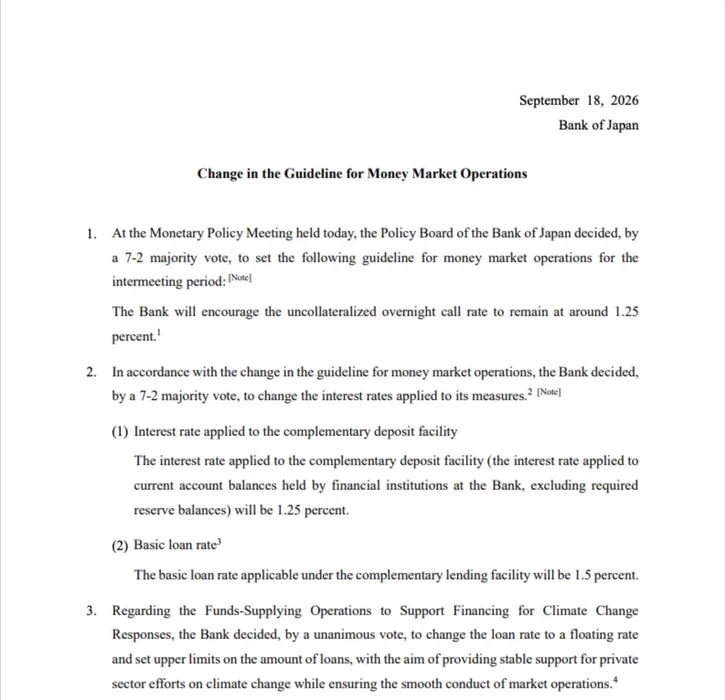
Policy Board members set their guideline for the uncollateralized overnight call rate at around 1.25%, effective September 24. The rate on the complementary deposit facility moves to the same level and the basic loan rate to 1.5%. The full wording is in the Bank of Japan’s statement on its money market operations guideline. It is the second 25 basis point increase in three months, after the June move to 1.0%.
Board members split on the decision. Governor Ueda Kazuo and six colleagues voted for it. Asada Toichiro dissented, arguing that with core CPI running below 2% recently the economy could not necessarily be called strong. Sato Ayano dissented as well, judging that economic and price developments had not accelerated enough to warrant a hike now. Two dissents on a widely expected move tell allocators the pace from here is contested inside the board.
Inflation drifting higher carries the rationale. The Bank of Japan says underlying CPI inflation has been approaching 2% and warns of a risk that it overshoots the target, as firms lean toward raising wages and prices. Producer prices keep rising on AI-related demand, high crude oil and yen depreciation. The board flagged the Middle East, AI demand and currency moves as the main risks to its outlook.
Markets had priced this in. A Reuters survey found 66 of 68 economists expected the move to 1.25%, and nearly 90% saw rates at 1.50% by March 2027. Pressure had also come from Washington, where Treasury Secretary Scott Bessent urged Japan to tighten faster to support the yen.

Why the Yen Weakened and Bitcoin Held
Immediate price action ran against the textbook. Bitcoin climbed to $77,400 from an overnight low of $76,200, and on bitFlyer the BTC/JPY pair gained 0.5% to ¥12.06 million. USD/JPY moved up to 156.70 from 156.20, which means the yen weakened on a rate hike. A fully priced decision leaves little room for a currency squeeze.
Behind the calm sits the yield gap. Borrowing in yen to fund higher-yielding positions elsewhere only unwinds when the funding cost rises fast relative to what the trade earns. With the Fed now at 3.75%-4.00% after the hike markets had priced at 90% before Wednesday’s meeting, the spread over 1.25% remains wide. A 25 basis point Japanese hike barely dents a gap that the Fed widened the same week.
Institutional flows were already leaning the right way. On Thursday, spot Bitcoin ETFs took in roughly $159 million, while ether funds lost about $39 million for a third straight day of outflows. That is not the profile of allocators bracing for a forced deleveraging out of Tokyo.
Japan also sits on the demand side of the crypto trade. Earlier this year, a wave of Japanese corporate treasuries turned to bitcoin as the yen collapsed under record hedge fund shorts. A slowly rising policy rate that does not reverse the currency leaves that rationale intact for now.
Also on CFinance:
- Clarity Act Passage Slips to 16% on Prediction Markets
- Bitcoin Allocation at 2.5% Models 8.6% Returns
- Rate Hike Expectations Reach 90% After Goldman Switches
A Wide Carry Spread Keeps Risk Budgets Open
The bull case rests on gradualism. If the Bank of Japan keeps moving in 25 basis point steps and the Fed holds or tightens further, the carry spread stays wide enough that nobody is forced to close yen-funded positions in a hurry. In that setup, Japanese policy becomes background noise for crypto allocators rather than a liquidity event.
One thing to notice is how differently this meeting played out from the one in June. Back then, a Fed hold and a same-day Bank of Japan decision raised the risk of a yen squeeze spilling into Bitcoin. This time the hike came with a weaker yen and a firmer Bitcoin. Two tightening cycles running in parallel narrow the scope for the kind of sharp spread compression that caused damage in 2024.
The ETF data supports a constructive read. With nearly $2.5 billion of net inflows into bitcoin funds over 30 days, the institutional bid was present going into the meeting rather than waiting on the sidelines. A decision that clears without incident removes one scheduled risk from the calendar.
The Bank of Japan Still Has an Unwind Trigger
A bear case starts with the board’s own guidance. The Bank of Japan says it will continue to raise its policy rate, and nearly 90% of economists surveyed by Reuters already see 1.50% by March 2027. Each step compresses the carry spread a little more, and the August 2024 precedent is the reference point: after a 15 basis point hike, Bitcoin fell from $70,000 to $49,000 as yen-funded positions were unwound.
Currency moves can arrive without a policy trigger. Earlier this month the yen strengthened as much as 2.5% in two days, and a rapidly strengthening yen is exactly what makes carry positions painful. The 10-year Japanese government bond yield crossed 3% for the first time since 1996 ahead of this meeting.
The two dissents cut both ways. They suggest a board that could slow down, but they also show the majority pushing ahead despite internal doubts about the strength of the economy. If inflation overshoots, as the statement warns it could, the pace would quicken, and a faster Bank of Japan meeting a pausing Fed is the combination that shrinks the spread quickly.
For now the asymmetry favors patience over hedging. The hike cleared, the yen weakened and bitcoin funds kept attracting capital. The risk to price is not this meeting but the sequence of the next ones, and whether the yen turns before the Fed does.
More to come.
About the Author