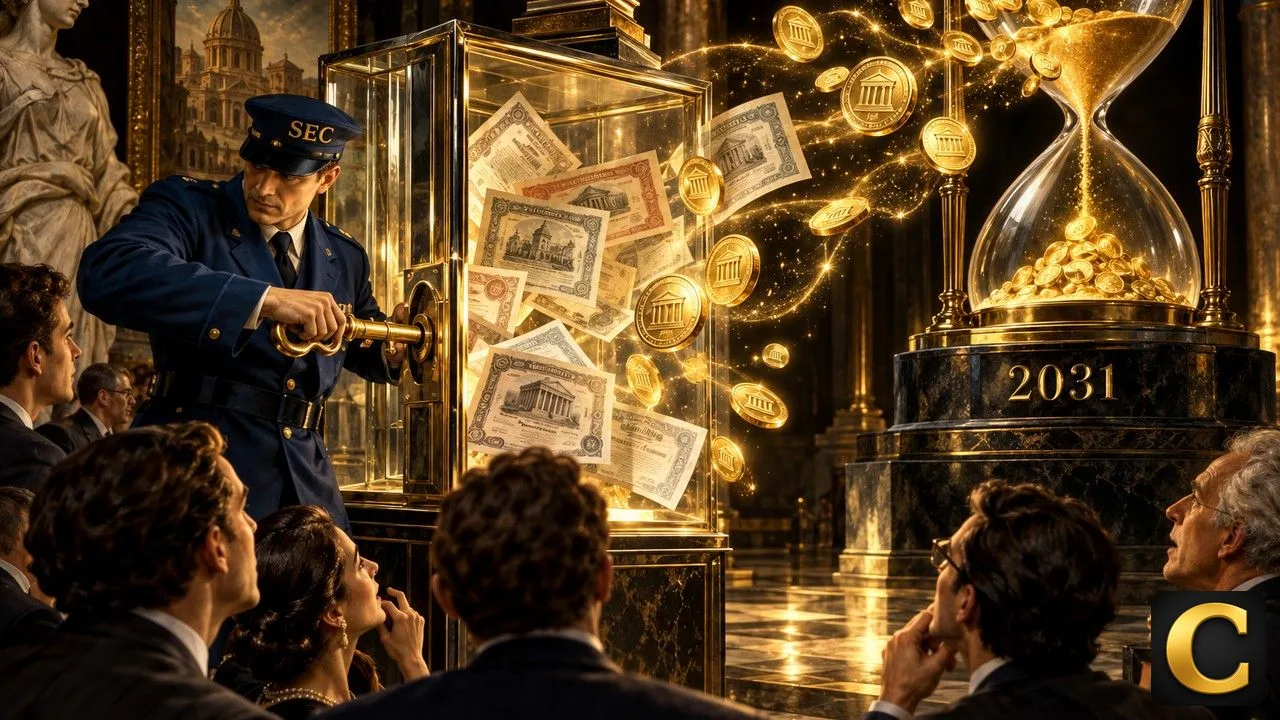
The Securities and Exchange Commission on Thursday granted a five-year conditional exemption that lets venues trade tokenized stocks on public blockchains without registering as a national securities exchange. The order, which the agency calls its Innovation Exemption, runs until September 17, 2031 and covers only tokens that carry the same rights as the underlying shares, dividends and votes included. Liquidity providers in those venues get a parallel exemption from dealer registration. It arrived two days after the Clarity Act failed a procedural vote in the Senate, which makes agency action the main route for market structure this year. For institutions, the order answers a narrow but useful question: under what conditions can a regulated firm run an automated market maker for real equity on a permissionless chain. The answer comes with tight caps, an issuer veto and a sunset date, and each of those shapes how much capital this market can absorb.
The Read
- Tokenized stock venues are exempt from exchange registration for five years, to 2031.
- Tier 1 venues can list up to 75 names at 0.25% of average daily volume.
- Synthetic price-tracking tokens are excluded and issuers can block third-party tokens.
Get This Analysis Summarized by AI
ChatGPTThe SEC Opens a Five-Year Window for Tokenized Stocks
Under that order, the SEC exempts what it calls Tokenized Securities Venues, or TSVs, from the definition of “exchange” under the Securities Exchange Act of 1934. A TSV brings together buyers and sellers of tokenized stocks through automated market makers and liquidity pools, while setting its own standards for who can access trading. The full terms are laid out in the SEC’s press release on the Innovation Exemption for tokenized NMS stock, which also opens a request for public comment.
Chairman Paul Atkins framed it as a bridge rather than an endpoint, saying the exemption, “while temporary, would allow TSVs to trade tokenized NMS stock in a permissioned environment today.” Jamie Selway, Director of the Division of Trading and Markets, called the approval an important milestone for opening capital markets to tokenized securities. The relief expires on September 17, 2031 unless the Commission replaces it with permanent rules.
The scope is deliberately narrow. Covered tokens can be issued by the company itself or by an unaffiliated third party, but they must represent the actual share. A third party issuing its own security that only tracks a stock price, such as a tokenized linked note or a security-based swap, falls outside. Only tokenized stocks with the same rights as the equivalent class of shares qualify, which rules out synthetic exposure products entirely.
Timing matters for reading this order. The Senate vote on the Clarity Act failed 49-50 on September 15, after prediction markets had already cut the implied probability of the bill’s passage to 16%. The SEC had been working on the exemption for more than a year, and it lands as part of Project Crypto, the joint SEC and CFTC effort to modernize digital asset rules, with more rulemaking on broker capital, record-keeping and exchange rules planned before year-end.

Tiered Caps Keep Tokenized Venues Small by Design
The conditions are where the order shows its intent. Venues face limits on how many symbols they list and how much they trade. For the most liquid names, a venue can list up to 75 tokenized stocks, with trading capped at 0.25% of average daily volume. A second tier allows up to 250 names, capped at 2.5% of average daily volume.
Applied to a single large stock, the cap is modest. Tesla trades roughly 40 million shares a day, so the Tier 1 limit works out to about 100,000 tokenized shares daily, or around $36.6 million at $366 a share. That is enough to run a live market and far too small to pull meaningful volume away from primary exchanges.
The technical requirements are specific. Smart contracts used by a TSV must be auditable, public and deployed on a public, permissionless blockchain, while access to trading stays permissioned through know-your-customer checks. Trading must halt whenever the underlying stock halts. Leverage and lending are not permitted under the exemption. The SEC’s fact sheet on the order lists self-custody, around-the-clock trading, fractional ownership and near-instant settlement as the benefits it is trying to capture.
Issuers keep a veto. Before a venue lists a stock tokenized by an unaffiliated party, it must give the issuer written notice and a chance to object, and at least 30 calendar days before operating it must publish a notice on its website and inform the Commission within one business day. The other side of this is the synthetic segment: products from Robinhood and Ondo that provide price exposure without ownership sit outside the framework as structured today, and so do the tokenized equity products Kraken offers, unless they are modified to meet the conditions.
Also on CFinance:
- Bank of Japan Lifts Rates to 1.25%, a 31-Year High
- Clarity Act Passage Slips to 16% on Prediction Markets
- Bitcoin Allocation at 2.5% Models 8.6% Returns
Real Tokenized Stocks Gain a Venue Without Congress
The bull case is that a regulated venue for real tokenized stocks now exists, and it did not need a statute. Firms built around issuer-sponsored tokens are the direct beneficiaries. Securitize shares rose 14% and Bullish gained 10% after the announcement, and names such as Superstate, Fairmint and Dinari fit the ownership-based model the SEC chose. The market is pricing the order as a win for issuer-backed tokenization over synthetics.
Institutions should read the dealer exemption closely. Liquidity providers that supply tokenized stocks to an AMM pool with proprietary capital, quote prices or commit capital are exempt from dealer registration, provided their securities activity stays inside TSV trading. That lowers the cost for a market maker to test onchain equity inventory without restructuring its broker-dealer footprint.
This order also fits a sequence. The SEC’s 421-page rewrite of its transfer agent rules added blockchain recordkeeping earlier this month, and the agency is preparing a roundtable on around-the-clock trading. Custody is the missing leg: the crypto custody rewrite went to the White House on August 25 with no text disclosed. Once those pieces align, issuance, recordkeeping, trading and safekeeping of tokenized stocks all have a defined path.
Blockchains that host the pools gain too. Ethereum, Solana and BNB Chain, along with DeFi venues such as Uniswap, Aerodrome and Raydium, are the infrastructure an AMM-based venue would plausibly build on. A permissionless chain requirement written into an SEC order is a signal that public networks can carry regulated equity trading alongside the private ledgers banks already run.
Caps, Vetoes and a 2031 Sunset Limit the Upside
The bear case starts with scale. A 0.25% volume cap on Tier 1 names keeps each venue marginal by construction, and the symbol limits stop any one platform from offering a full market. For an allocator, that means tokenized stocks under this order work as an operational pilot, too small to change execution costs.
Issuer veto rights add friction on the supply side. A company that does not want its shares tokenized by a third party can block a venue from listing them, which leaves third-party tokenization dependent on issuer goodwill. Issuer-sponsored tokens are the only fully reliable path.
Durability is the deeper weakness. An exemptive order can be modified or withdrawn by a future Commission, and the failure of the Clarity Act means there is no statute underneath it. Here is why that matters for planning: a firm that builds a venue now is investing against a five-year window that ends in 2031, with no guarantee of what replaces it.
Other jurisdictions are moving on longer horizons. South Korea gives tokenized securities legal standing from February 2027, through legislation rather than an agency order. The asymmetry for US institutions is clear: the SEC has opened the door faster than Congress could, but through a structure that is small, conditional and reversible, and the 2031 sunset is the number to model against.
More to come.
About the Author