

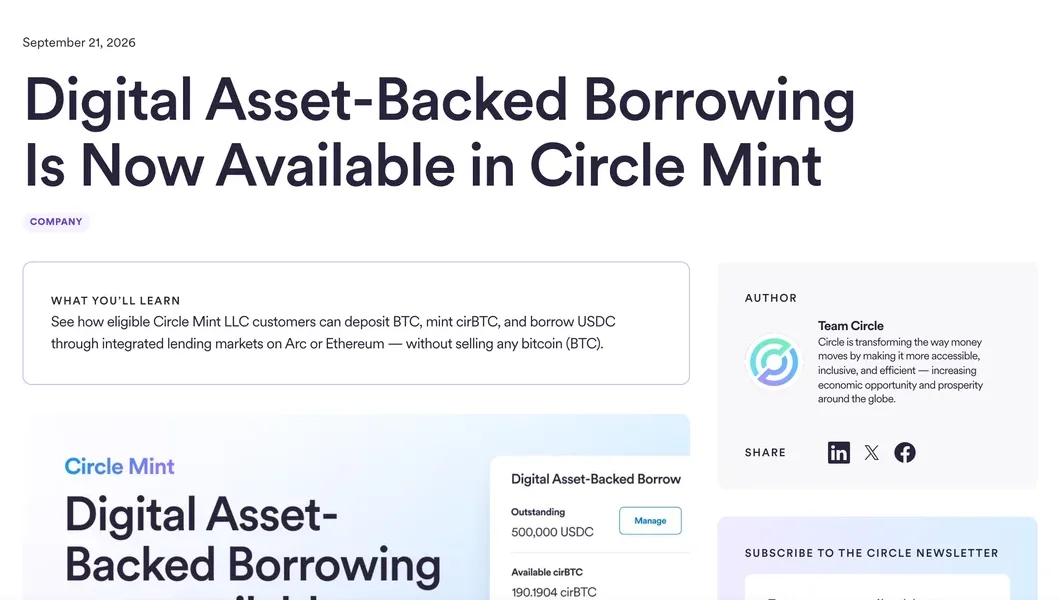
Circle switched on USDC borrowing against bitcoin collateral for eligible Circle Mint clients on Monday, routing the credit leg through third-party lending markets rather than its own balance sheet. The product, Digital Asset-Backed Borrowing, lets a treasury deposit BTC, mint Circle Wrapped Bitcoin, post it as collateral and receive USDC without selling the underlying position. Live Morpho data on Tuesday showed $18.86 million of outstanding borrowing against $157.85 million of available liquidity on Arc, which places the launch closer to a pilot than to a scaled facility. The distinction matters for anyone sizing counterparty exposure, because the lending market sets the liquidation threshold and the collateral terms, and those parameters sit outside the issuer’s control. What follows covers the mechanics as shipped, the balance-sheet logic that makes it attractive, and the risk transfer buried in the routing.
The Read
- USDC borrowing goes live on Circle Mint across Arc and Ethereum, New York residents excluded.
- Morpho carries the first live market, with an 86% liquidation loan-to-value on cirBTC.
- Outstanding borrowing sits at $18.86M against $157.85M of available liquidity.
Get This Analysis Summarized by AI
ChatGPTWhere USDC Borrowing Sits in the Mint Workflow
USDC borrowing lands inside Circle Mint, the interface institutional clients already use to create and redeem the stablecoin. That placement is the product decision. A treasury does not open a separate venue, it borrows from the same screen where it handles stablecoin issuance.
The sequence runs in four steps. The client deposits BTC, mints Circle Wrapped Bitcoin backed one for one, supplies that token as collateral to a supported lending market through a wallet it controls, and the borrowed USDC lands directly in the Circle Mint balance. The custody leg sits with Circle National Trust, a federally chartered trust bank and qualified custodian.
USDC borrowing is available on Ethereum and Arc, the chain Circle brought to mainnet earlier this month with USDC as its native gas token. Wrapped bitcoin had already debuted on Ethereum in June, so the Arc listing completes a two-chain footprint rather than opening a new asset.
New York residents are excluded at launch, a carve-out that usually signals a state licensing question still in progress. Circle has been building the regulated wrapper around this business for a while, and the market reaction to its Open USD launch in July showed how closely equity holders track each expansion of the product surface.

Why a Treasury Reaches for USDC Borrowing Instead of Selling
The balance-sheet case is straightforward. A corporate treasury holding BTC as a long-term reserve asset needs working capital periodically, and selling crystallises a taxable event plus a reinvestment decision nobody wants to make twice. USDC borrowing converts the position into liquidity while the exposure stays on the books.
On Arc, Morpho runs the USDC borrowing market that accepts the wrapped token as collateral, with a liquidation loan-to-value threshold of 86%. Positions are overcollateralised by construction, which means a treasury borrowing conservatively at 40% or 50% keeps a wide buffer before any forced unwind comes into view.
Now compare USDC borrowing with the alternative institutional route. Bilateral crypto-backed lending desks quote wider, demand negotiated documentation and carry single-counterparty risk that a credit committee has to underwrite by name. A published on-chain market with a visible threshold is easier to model, even when the underlying protocol risk is harder to price.
Circle documented the full workflow in the product note published alongside the Circle Mint rollout, including the wallet-controlled collateral model that keeps the client in possession throughout.
Also on CFinance:
- Saylor’s Strategy Resumes Buying With 950 Bitcoin
- Bitcoin ETF Holders Back in Profit as Inflows Near $1B
- Binance MiCA Bid Blocked by Lagarde, WSJ Reports
The Distribution Case Behind the Timing
The launch arrives in the same week Binance took a $100 million equity stake in Circle and signed a five-year agreement to push USDC across emerging markets. Read together, the two moves describe one strategy: widen the number of reasons an institution ends up holding USDC rather than a competing stablecoin.
USDC borrowing demand proves stickier than trading demand, which is the point. A treasury that has posted bitcoin collateral against a USDC loan cannot rotate to another stablecoin without unwinding the position first. Credit creates switching costs that liquidity incentives never do.
The competitive frame is visible in the market share numbers, with the leading issuer having reclaimed ground earlier this year when USDT crossed a $190 billion market capitalisation. Circle is answering on utility rather than on distribution alone.
If the model works, the qualified-custodian leg becomes the selling point that compliance teams actually care about. That argument gets stronger as the rulebook firms up, and the custody proposal now sitting under White House review is the file to watch on that front.
Where the Risk Actually Sits Once You Read the Routing
The issuer originates the USDC borrowing workflow while the loan itself sits elsewhere. Collateral requirements, interest rates and liquidation thresholds are determined by the third-party lending market, which means a client borrowing through Circle Mint carries protocol risk on Morpho while Circle keeps the credit risk off its own book. That transfer is disclosed, and it is easy to miss.
Size tells its own story. $18.86M drawn against $157.85M available is a utilisation rate near 12%, which reads as a market waiting for its first real users rather than one clearing institutional demand. Thin utilisation also means the interest rate observed today says little about the rate a larger borrower would face.
That 86% threshold on USDC borrowing deserves the same scrutiny. In a disorderly bitcoin drawdown, liquidations on a wrapped asset depend on the depth of the secondary market for that specific wrapper, which can run far thinner than BTC spot liquidity. A wrapper with modest float can gap even when the underlying trades normally, and the peg mechanics involved are the same ones that decide whether a token holds its dollar value under stress.
One thing to notice is the asymmetry for an allocator. The upside is operational, measured in tax deferral and preserved exposure. The downside is structural, sitting in smart-contract risk and wrapper liquidity, and it does not scale down with the size of the loan.
More to come.
About the Author