
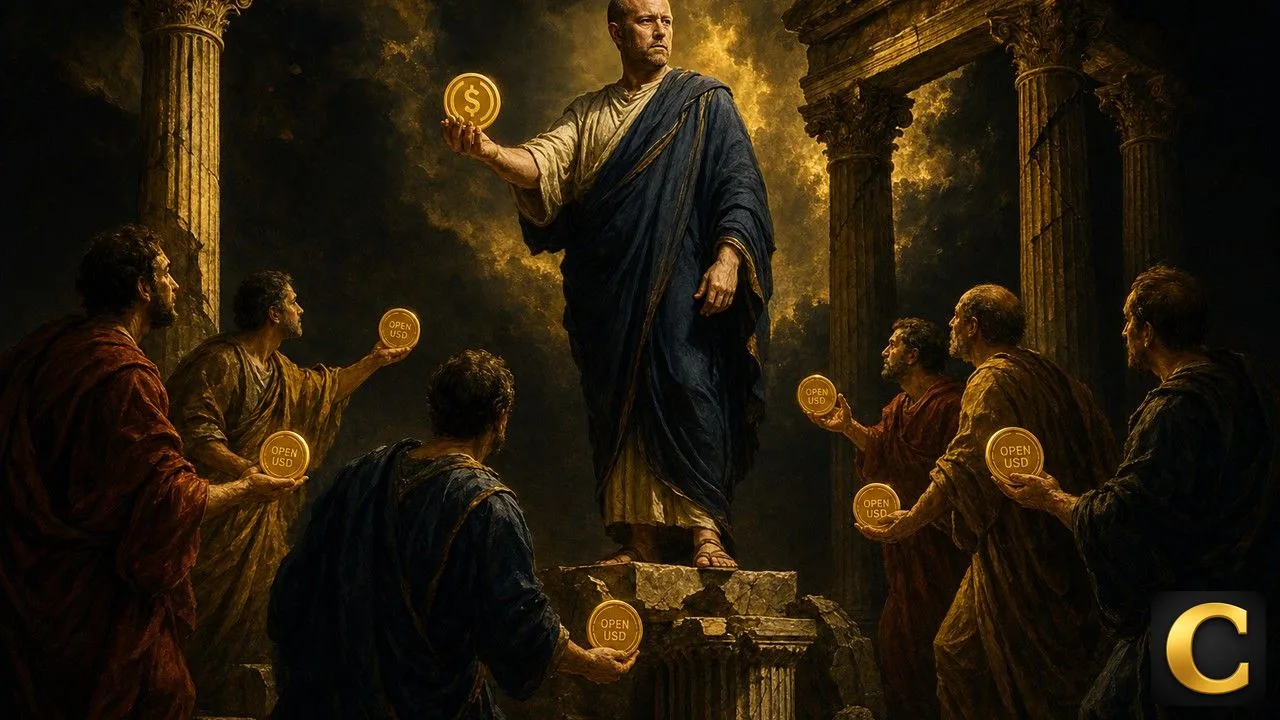
Circle Stock crashed 16% in a single session after a consortium of 140 partners unveiled Open USD, a rival stablecoin designed to break the USDC playbook. Coinbase, BlackRock, Visa, Mastercard, Stripe and Google all sit on the founding partner list. Circle Stock (CRCL) closed the day near $63.99, extending a monthly decline that now reaches 39%. The market read Open USD as an existential threat to the reserve income Circle relies on.
Key Takeaways
- Circle Stock (CRCL) fell close to 16% in one session to about $63.99, and is down 39% over the trailing month.
- Open USD launched with 140+ founding partners including Coinbase, BlackRock, Visa, Mastercard, Stripe and Google.
- The new stablecoin promises free, uncapped minting and redemption, with reserve income shared across the partner network instead of a single issuer.
The single-day repricing of Circle Stock
Circle Stock had been drifting lower since May, but Tuesday’s session was different. As the Open USD announcement hit the tape, CRCL fell close to 16% intraday and settled near $63.99. The volume profile pointed to institutional repricing, not retail panic, with block trades hitting the market in the first hour of trading.
The monthly picture makes the move even more brutal. Circle Stock is down 39% over the last thirty days. Crypto-linked equities had already been trailing the broader tech sector, with names like Coinbase and MSTR feeling the pressure. Circle stood out even inside that group, because its business model is uniquely dependent on the yield generated by stablecoin reserves at a moment when everyone is going after that revenue pool.
USDC generates its income by parking user deposits in short-duration Treasuries and other rate-sensitive instruments. As long as Circle is the dominant regulated dollar-backed stablecoin, that income stream is protected. The Open USD launch says explicitly that the consortium wants to redirect the same yield to a shared partner pool rather than a single balance sheet.
The presence of Coinbase on the Open USD partner roster is what made the equity move brutal. Coinbase is Circle’s closest strategic ally, the exchange that has distributed USDC to the widest audience and receives a share of reserve income under a longstanding agreement. Seeing Coinbase back a direct competitor to USDC signals that the alliance is being repriced, or at least hedged against.
Buy-side analysts spent the session recalibrating the earnings model. If Open USD gains real distribution over the next twelve to eighteen months, USDC’s growth ceiling gets lowered. And if reserve yield gets normalized down to zero for issuers as the new default, the entire discounted cash flow model behind Circle Stock has to be redrawn.

Open USD, a design built to disrupt USDC
Open USD is being operated by a nonprofit-style entity called Open Standard, run by CEO Zach Abrams. Abrams is a familiar face inside the crypto stablecoin infrastructure. He came out of Bridge, the stablecoin startup that Stripe acquired last year, and he has now moved into a coordinator role for the consortium.
The design principles that Open Standard published position the product as a neutral piece of infrastructure. Minting and redemption are advertised as free and uncapped, which removes one of the main friction points that Circle and Tether use to monetize integrators. Reserve income does not flow back to a single issuer. It gets distributed across a defined pool of partner businesses via an economic model set at the consortium level.
Governance is also structurally different. Open Standard is governed by a board drawn from partner companies, not by a single corporation. That layout is meant to reassure regulators and skeptical partners that no one seat has an unfair grip on the token. It also creates a moat against being swept up in issuer-specific regulatory issues, since the governance blast radius is spread across dozens of participants.
The initial partner list reads like a Fortune 100 census. BlackRock, Visa, Mastercard and Stripe are all directly present. Google adds a payments and infrastructure vector. Coinbase brings the distribution rail into crypto natives. Together they form a customer set that could adopt Open USD as internal payment infrastructure even before it hits retail user wallets.
Launch is scheduled for later in 2026. The token has not started circulating yet, and the exact chain footprint at launch has not been confirmed publicly. That leaves a window where Circle can still react, either by revising its Coinbase revenue-share arrangement or by moving faster on its own institutional distribution. For context, see our earlier piece on CFinance: Crypto Stocks Fall Twice as Fast as Big Tech in 2026.
Also on CFinance:
- Trillion-Dollar Stocks: Micron is Cheapest, SpaceX Priciest
- SBI Bitbank: $289M Deal Marks Japan Crypto Consolidation
- Framework Ventures Raises $400M for AI and Robotics Fund
What it changes for the stablecoin market
The Open USD launch is the clearest signal so far that the stablecoin category is heading toward commoditization on the yield side. USDT and USDC have both been printing very healthy margins by keeping most of the reserve income for themselves. That regime is now openly contested by a coalition big enough to force new pricing conventions on the market.
For the largest partners, Open USD is also a hedge. Visa, Mastercard and Stripe have built entire payments businesses over decades and would prefer a stablecoin layer that does not sit inside a single vendor. BlackRock has already been positioning itself as the reserve manager of choice for tokenized dollars. Having a stablecoin governed by a broad consortium removes the risk of being locked out of the rail by an incumbent issuer.
Circle now has to answer with a repositioning. The company can lean on its regulatory head start under the GENIUS Act, on its US bank licenses in progress, and on the depth of USDC integrations across DeFi and payments. But it can no longer count on the assumption that being the credible regulated stablecoin was enough to protect its yield model.
Tether sits in an oddly similar position from the outside. USDT has always relied on distribution moat rather than governance quality. Open USD threatens both stablecoin leaders at once, but with different pressure points. USDC risks losing the regulated-institution flow. USDT risks losing the international payment corridors where the largest partners already operate.
For the wider crypto stock complex, the Tuesday session was also a reminder that the sector still trades on narrative fragility. Coinbase held up better than Circle because its revenue base is more diversified, but the read-across on stablecoin business lines was immediate. Expect the next earnings calls at Circle, Coinbase and the payments incumbents to spend most of their time on the Open USD question.
More to come.
About the Author