
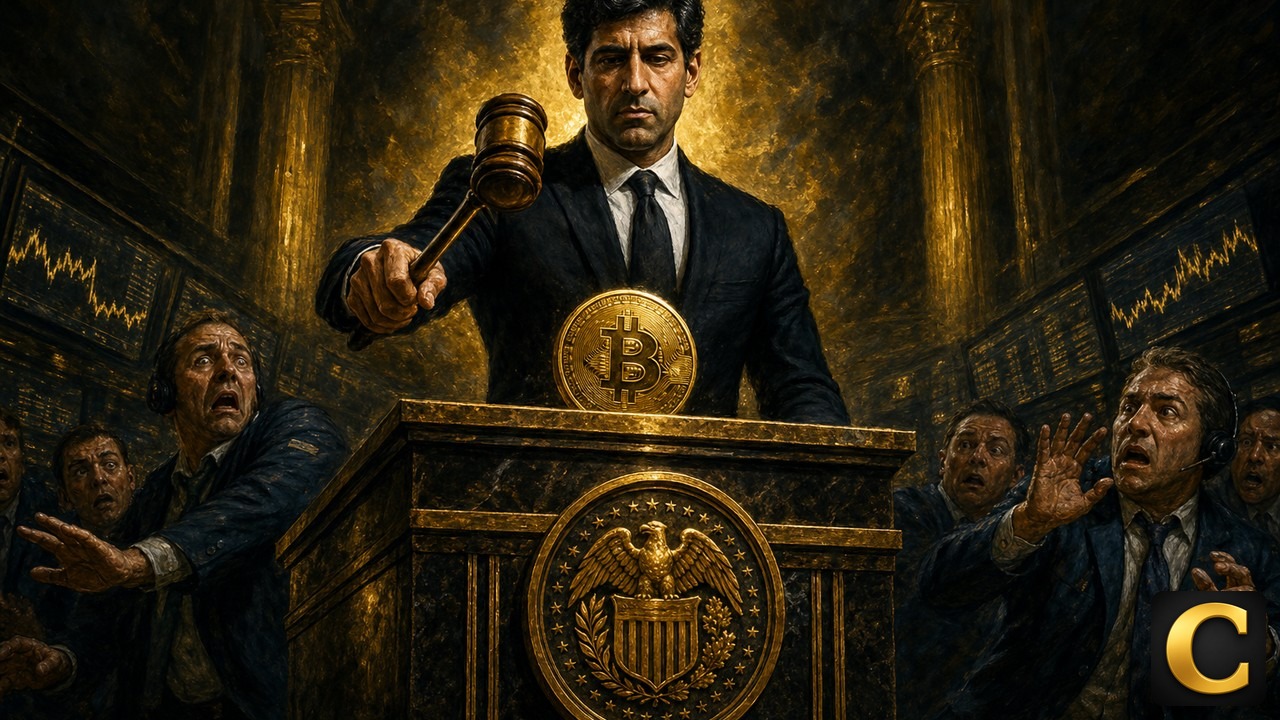
The Federal Reserve is holding its benchmark rate at 3.5% to 3.75% while futures markets now price in a 60% probability of a rate hike before the end of 2026, a complete reversal from the early-year consensus of multiple cuts. Bitcoin fell below $62,000 on June 4 with $1.5 billion in liquidations as investors rotate capital away from risk assets and into gold and AI stocks. The Fed’s June 17 meeting, the first chaired by new Chair Kevin Warsh, represents the next major test for crypto markets and equity portfolios alike.
Key Takeaways
- Fed holds at 3.5%-3.75%; 60% probability of a hike priced in before year-end
- Kevin Warsh chairs his first FOMC on June 17 with a hawkish tone widely expected
- Bitcoin below $62,000 reflects capital rotating to gold and AI stocks, not a crypto-specific event
The Fed Stays Put, but the Outlook Has Shifted
The Federal Reserve maintained the federal funds target range at 3.5% to 3.75% at its last meeting. The rate itself has not moved. What has changed, dramatically, is the direction the market now expects it to travel.
Earlier in 2026, consensus positioned the Fed for several cuts over the course of the year. Inflation was expected to cool steadily, and rate-sensitive assets including Bitcoin and equities priced in a dovish pivot. That scenario has unwound. U.S. inflation rose to 3.8% in April 2026, the highest reading since September 2023, driven in part by persistent energy price pressures. Core CPI climbed to 2.8% year-on-year at the same time.
CME FedWatch data now shows a 60% probability of a rate hike before year-end, a figure that reflects genuine uncertainty rather than a minor repricing. Traders who entered 2026 positioned for easing are being forced to reassess across every asset class.
For fixed-income investors, this matters directly. Higher rates for longer compress the present value of future cash flows, making speculative assets with no yield component less attractive on a risk-adjusted basis. Bitcoin falls squarely into that category.
The broader macro backdrop includes renewed geopolitical tensions contributing to oil price uncertainty, which in turn feeds back into inflation expectations. The Fed’s room to maneuver remains constrained by data that keeps refusing to cooperate with the dovish narrative.

Kevin Warsh’s First FOMC: June 17
The June 17 Federal Open Market Committee meeting carries additional weight because it will be the first chaired by Kevin Warsh, who officially became the 17th Federal Reserve Chair on May 22. The full picture is available in The Federal Reserve’s June 17 FOMC statement.Warsh’s arrival signals a tonal shift that markets have been pricing in since his appointment was confirmed. Consensus leans toward inaction, the Fed likely to hold rates at 3.5-3.75% on June 17.
Warsh’s track record and public statements lean hawkish. He has consistently emphasized the risks of premature easing and the Fed’s credibility problem if it declares victory on inflation before the data supports it. His first press conference will be scrutinized for any shift in the Fed’s reaction function, particularly around the threshold for a rate adjustment in either direction. Warsh carries that stance into Washington, heading to Congress with inflation still at 3.4%.
The timing is uncomfortable. June Nonfarm Payrolls data drops on June 5, two weeks before the FOMC meeting. A strong labor market reading would give Warsh cover for a hawkish posture at his debut. A softer number could complicate the messaging but is unlikely to pivot the committee given the inflation backdrop.
Beyond the rate decision itself, the June meeting will include updated economic projections and a revised dot plot. Markets will look specifically at how many committee members project a hike in 2026 versus a hold. A majority signaling a potential hike would represent a significant tightening of financial conditions, even without an immediate action.
The institutional calendar is set. How Warsh handles the press conference and how the dots align will define the macro tone for the rest of the summer.
What the Fed Means for Bitcoin and Institutional Portfolios
The connection between Fed policy and Bitcoin is no longer indirect. Analysts at Presto Research note that Bitcoin’s major drawdowns in 2026 have coincided with rallies in gold and AI stocks as investors scale back rate-cut expectations. The June 4 drop below $62,000 with over $1.5 billion in liquidations is the latest data point in that pattern.
U.S. spot Bitcoin ETFs are tracking approximately $1 billion in net outflows this week, extending a streak of consecutive withdrawals. Bitcoin ETFs recorded 10 straight sessions of net outflows going into this week, a signal that institutional reallocation away from crypto is ongoing rather than episodic.
The mechanism is straightforward. When rates are expected to stay elevated or move higher, capital with a yield mandate leaves non-yielding assets. Gold gains as an inflation hedge. AI equities gain as a growth story. Bitcoin, which offers neither yield nor a clear inflation hedge narrative at current valuations, loses in that allocation competition.
Presto Research analysts frame the recovery condition clearly: a sustained Bitcoin rebound depends on inflation easing and renewed appetite for liquidity-sensitive assets. That condition is not met today. The April CPI print at 3.8% and the 60% rate-hike probability leave limited room for the Fed to pivot before the data changes materially.
For portfolio managers, the June 17 meeting is the next decision point. A hawkish outcome cements the current rotation away from risk assets. A more balanced message opens the door for a technical recovery in Bitcoin and crypto-adjacent equities. The spread between those two outcomes has real consequences for asset allocation through the second half of 2026.
Follow the story on CFinance.
About the Author