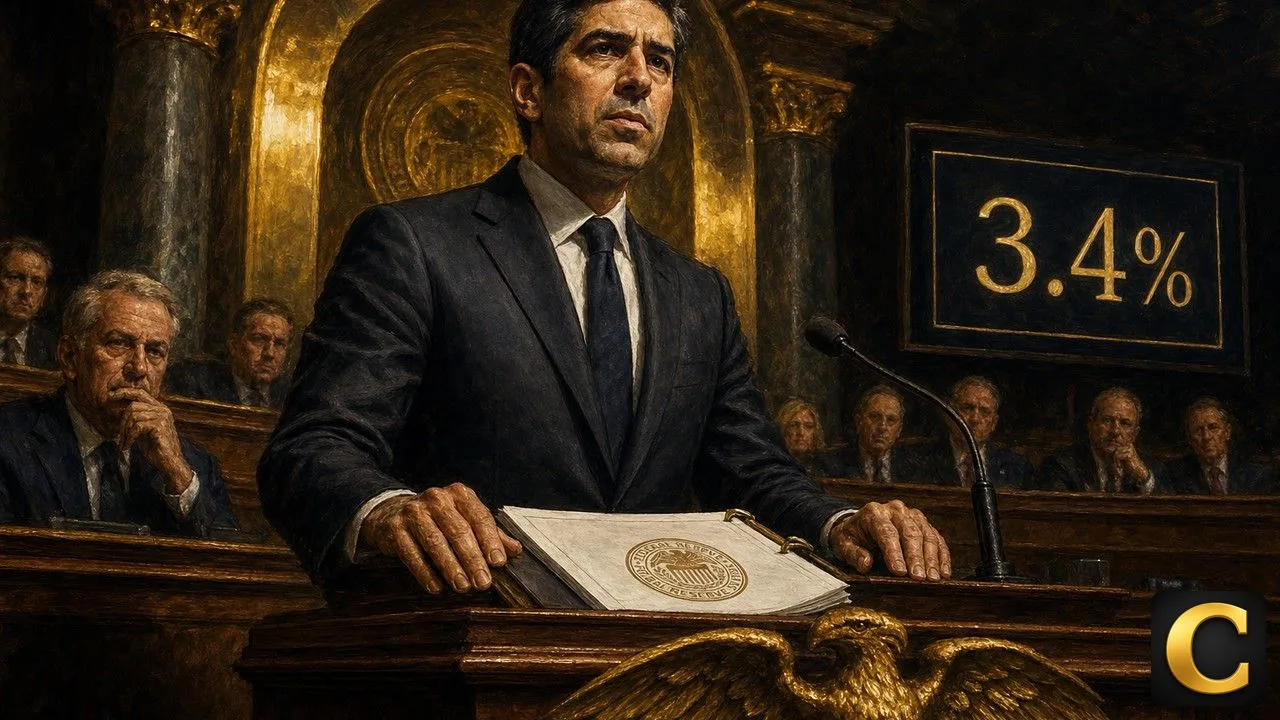
The Federal Reserve delivered its semiannual monetary policy report to Congress on Friday, and the message is exactly the one Warsh already teed up in his first FOMC meeting. Price stability comes first, inflation is still running too high at a core PCE of 3.4% over the twelve months to May, and the Committee is prepared to act forcefully if longer term expectations start drifting. What makes this cycle different is the timing. Warsh testifies before the House Financial Services Committee on Tuesday and the Senate Banking Committee on Wednesday, and the June CPI print lands the same morning as his House appearance. Four hearings worth of narrative and one inflation number will decide whether the Committee’s next move looks like a cut or another hike.
The Read
- Warsh testifies Tuesday and Wednesday, June CPI print lands the same morning as the House hearing
- Core PCE at 3.4% keeps hike optionality on the table despite easing gasoline
- Almost half of the FOMC dot plot still projects at least one 2026 hike
Warsh Delivers His First Semiannual Report With Core PCE at 3.4%
The report emphasized that the Committee will deliver price stability, repeating the exact language the FOMC used at its most recent meeting last month. That is the sentence the Senate and House will chew on all week. It signals the Committee is not softening its posture toward the two percent target even as headline inflation drivers rotate.
The Fed pointed to three inflation drivers in the report. Tariff pass through, energy price spikes tied to renewed Middle East tensions, and demand pressure from AI supporting technology capex. That last one is unusual in a Fed policy report. It reframes AI infrastructure as a macro variable, not just a sector story, and it sets up the case that the memory chip and AI accelerator cycle is going to keep pushing on core services inflation for another quarter.
Warsh also flagged five new task forces during the semiannual cycle. Public communications, balance sheet policy, data source quality, the inflation examination framework, and how AI could reshape productivity and jobs. Task forces are not policy tools, they are governance signals, and creating five of them within months of taking the chair tells the Senate that Warsh is running an institutional review as much as a rate cycle.
Longer term inflation expectations, the metric the Fed watches to decide whether it has to hike, sit within the pre pandemic range according to the report. That is what buys the Committee optionality. As long as the anchor holds, Warsh can stay hawkish in language without actually moving the funds rate.

The FOMC Dot Plot Still Has Nearly Half the Committee Ready to Hike
The dot plot from Warsh’s first meeting told a story rate cut markets did not fully price. Almost half of the participating members projected at least one hike in 2026, a level of hawkish dispersion unusual this deep into a pause. Two year yields sit above 3.85%, roughly 20 basis points above where they traded when Powell was still framing the cycle. The market has already partially adjusted. The June 17 FOMC hold was the moment that repricing started.
Warsh’s public statements between the June FOMC and Friday’s report have been consistently more assertive than Powell’s late cycle. He walked through the framework by insisting that inflation risks had diminished but that the level was still unacceptable, an anti Powell phrasing that reads as prep work for hawkish testimony. The hike implied probability from OIS rose from around 40% at the June meeting to roughly 60% into the July 14 CPI window. The 60% hike probability is where positioning currently leans.
Positioning matters here because a hawkish surprise on Tuesday hits the rate sensitive parts of the tape hardest. Growth equities, long duration credit, spot bitcoin ETFs. Spot bitcoin ETFs already bled nearly $5B in Q2, the largest quarterly outflow since launch. Another hawkish repricing accelerates that unwind mechanically. A dovish surprise runs the same trade in reverse and could pull bitcoin above the $65K level analysts have been watching.
Falling Gasoline Sets Up a Cleaner June CPI Print Tuesday
The bull case for a dovish outcome rests on gasoline. WTI has retraced back to pre conflict levels and June retail fuel prices are on track for a monthly decline. That mechanically clips the headline CPI print released Tuesday morning. Robin Brooks at Brookings put it as the deflationary impulse from falling oil reminding everyone the Fed is not going to hike and that the next move is likely a cut. It is the cleanest bull framing in circulation this week.
The tape has already started sniffing that scenario. Two year yields eased four basis points into Friday’s close, and equity vol collapsed with the VIX finishing under 15. That is not a market bracing for a hawkish week. It is a market that thinks the CPI print goes below 2.9% year over year and gives Warsh cover to soften the language in his second day Senate appearance.
If the print delivers, positioning flips fast. The June CPI print becomes the pivot moment for the second half. Bond duration re adds, growth outperforms value and September hike odds collapse toward 20%. That is the version of Tuesday morning that Warsh would prefer to walk into. It also gives him room to argue that the anchor is holding without cutting. That pivot did arrive, though a cool CPI print alone won’t justify buying crypto.
The task force on AI productivity fits this framing well. If AI capex compresses services inflation over the next twelve months by lifting output per hour, the Fed can hold rates without hiking again. That is the disinflationary tail nobody in the sell side has priced properly yet.
Tariffs and Middle East Energy Spikes Still Keep the Hike Path Alive
The bear case builds on the other two drivers the report flagged. Tariff pass through is still working through the goods basket, and the Middle East energy corridor is unstable enough that any renewed strike sends Brent back above $75. Both push core services and core goods higher on a six week lag, and the Fed cannot look through that with core PCE already at 3.4%.
The oil setup is the fragile piece. WTI has been back near pre conflict levels for only two weeks, which is well below the durability window Warsh usually needs before treating a print as clean. Any escalation in the Strait of Hormuz undoes the gasoline dividend by August. The Iran shock in June already produced the June oil spike that pushed Brent to $74 and rattled risk assets for a week, and the second order tail is what the bear case leans on.
Warsh’s task force on inflation examination is the tell here. Reviewing how the Fed defines and measures inflation is prep work for redefining the target upward under pressure, or for arguing tariff driven inflation is transitory and can be looked through. Both scenarios are hawkish in the short term because they require Warsh to hold rates or hike to defend the anchor while the review runs.
The market is not pricing this bear scenario symmetrically. OIS hike odds at 60% imply the market is slightly leaning hawkish, but two year yields at 3.85% look calm compared to the 4.10% they hit during the last inflation scare. If Tuesday’s CPI comes in above 3.1% year over year, expect a fast repricing back to 4.10%. That is the asymmetry the reader has to price in.
More to come.
About the Author