
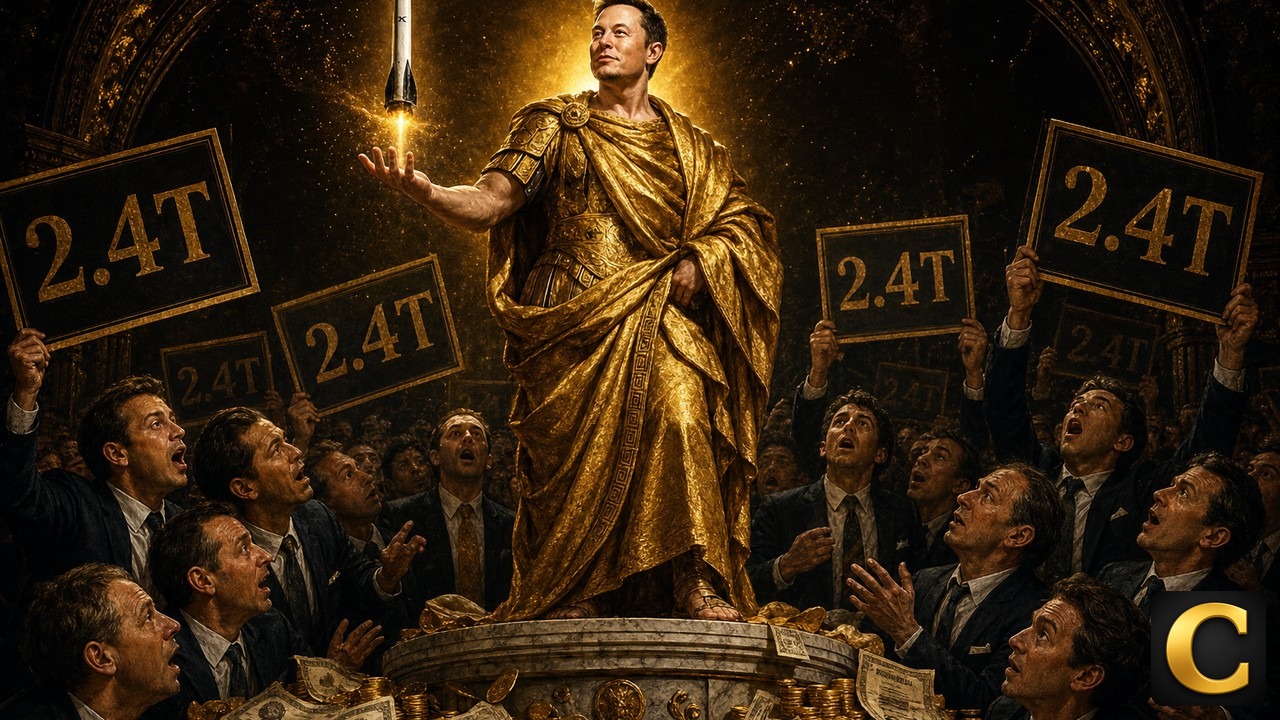
The SpaceX valuation read by crypto-traded venues sits near $2.4 trillion after Friday’s Nasdaq debut, well above the $1.75 trillion struck at the $135 IPO price. Hyperliquid’s SPCX perpetual cleared $216 million in open interest, while Polymarket assigned a 70% probability of a $2 trillion-plus first-day close. The gap captures retail and offshore appetite that traditional book-building never priced. The next mega-IPOs are about to be measured by the same yardstick.
Key Takeaways
- Crypto-traded venues mark the SpaceX valuation at $2.4 trillion, against the $1.75 trillion IPO level
- Hyperliquid SPCX hit $216 million in open interest and over $150 million in 24-hour volume on debut
- Polymarket priced a 70% probability of a $2 trillion-plus close on first trading session
The $2.4 Trillion Crypto-Traded Mark That Outran the IPO
The bankers set the SpaceX IPO at $135 per share, a $1.75 trillion valuation. The market took a different view almost immediately. By the time the stock opened on Nasdaq on Friday, it traded above $160, and the implied valuation began to climb toward levels that the underwriting consortium had explicitly avoided printing on the prospectus.
The crypto-traded venues had already done that work. IG International derivatives priced the SpaceX valuation near $2.4 trillion ahead of the open, building on weeks of pre-IPO trading. The gap with the official IPO price was not marginal. It marked a 37% premium between what books accepted and what the broader retail and offshore demand was willing to pay.
Polymarket added another layer. Conditional markets gave the IPO a 70% chance of closing above $2 trillion on its first trading session. That probability is not a price, it is an integral of every participant’s expectation, marked to market every second. For a deal of this size, with no comparable benchmark in the public listings of the past decade, the signal is hard to ignore.
The context built up over the past week reinforces the read.As described in the SpaceX Nasdaq debut at $1.75T, the pricing landed below the highs of the pre-IPO trade.The Friday session has now closed part of that gap, and the crypto-traded mark suggests there may still be more room before the demand is fully absorbed. The full picture is available in SpaceX’s official IPO pricing announcement.
For traditional equity desks, the lesson is concrete. The SpaceX valuation discovery did not start at the open of Nasdaq trading. It started weeks earlier, in venues that were not on their radar. The IPO price was set against an information set that excluded a significant slice of the demand curve.

How Onchain Markets Became Pre-IPO Barometers
Hyperliquid SPCX is a cash-settled perpetual indexed on the SpaceX valuation. Settlement is in cash only, and the contract grants neither voting rights nor any claim on the firm. It is a derivative whose only function is price discovery, available 24 hours a day, with leverage, cross-margin and funding rates. As SpaceX began trading on Nasdaq at $135, SPCX cleared between $176 and $183, an implied premium close to 36%.
The numbers behind that signal are unprecedented for a non-crypto reference. Open interest peaked at $216 million on Friday, with 24-hour volume above $150 million. For a venue that historically priced crypto perpetuals, hosting that kind of liquidity on a single US equity reference is a structural change.
The trajectory leading to that print matters. SPCX touched highs near $216 in May, a 60% premium to the IPO mark that was eventually set, before retracing to $153 earlier this week as the listing approached. The Friday rebound closed part of that drawdown without erasing it, leaving the contract in a stable premium range that the open market quickly validated.
For hedge funds and family offices, this is more than a curiosity. Until now, expressing a view on a pre-IPO equity required navigating opaque secondaries, dedicated funds or OTC blocks, all carrying significant friction. A liquid perpetual on a public orderbook collapses that cost, and it reshapes the way the SpaceX valuation was even debated in trading rooms during the weeks leading to the listing.
What the Next Mega-IPOs Inherit From SpaceX
The SPCX precedent will not stay isolated. As covered in the broader build-up to the $1.8 trillion IPO, SpaceX was the first listing where the pre-IPO derivative trade became a fully observable, market-grade input. The next candidates are already on the table.
OpenAI confidentially filed an S-1 earlier this month. Anthropic is widely expected to follow. For both, the SpaceX template suggests that crypto-traded valuation will price each name well before the bankers stamp a final number. Whether underwriters integrate those signals or ignore them will define the gap between IPO and first-day close.
The risk side of the equation is sharper than it was. Cash-settled perpetuals indexed on US equities sit in a regulatory zone that has so far been left alone. The size now visible on SPCX is likely to draw scrutiny from the SEC and the CFTC, especially if retail losses materialize on subsequent listings. The instrument can be structured to avoid security qualification by design, but regulatory tolerance is not guaranteed.
For investors used to traditional book-building, the conclusion is straightforward. The SpaceX valuation set on Friday is a hybrid price, with an onchain layer that is no longer optional to track. The next major listing will not be priced in a vacuum, and the desk that ignores Hyperliquid, Polymarket and IG will be working with half the picture.
Follow the story on CFinance.
About the Author