
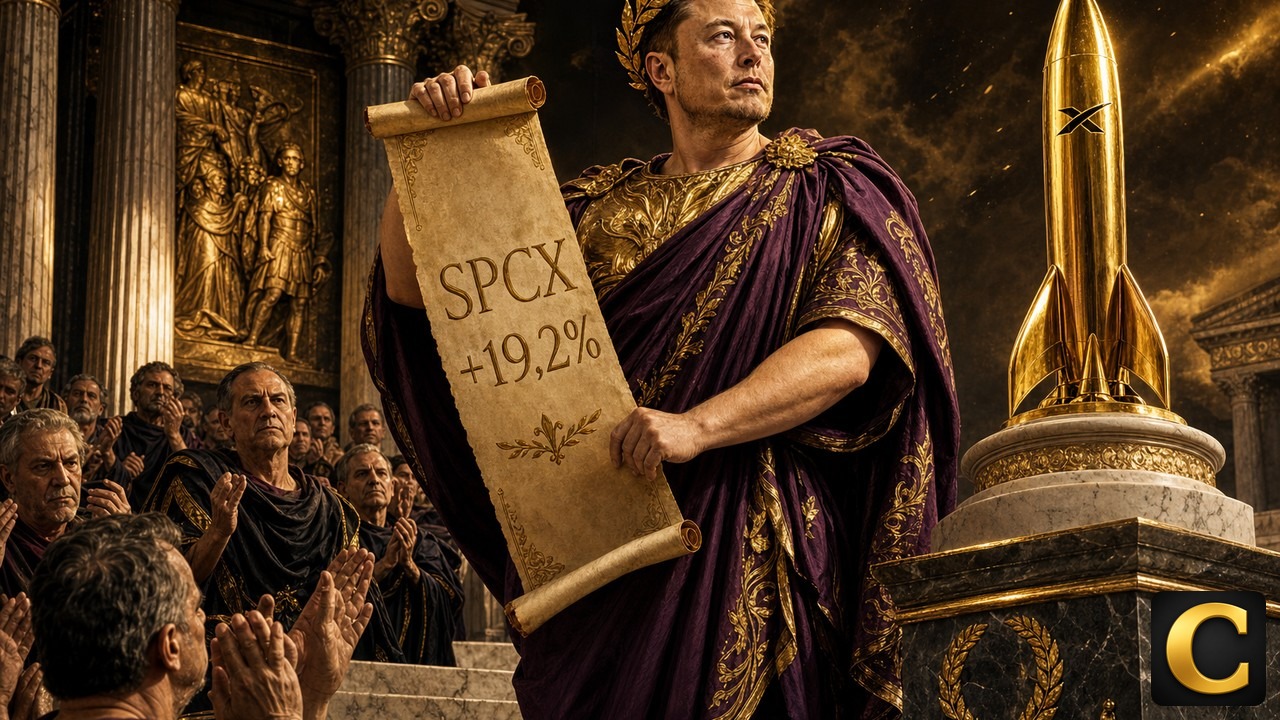
SpaceX stock closed up 19.2% on its first trading day. SPCX opened at $150, climbed to $160.95 at the bell and pushed Elon Musk’s space company to a $2.104 trillion market cap. The order book hit four-times oversubscription, with roughly $250 billion in orders chasing a tiny 4% float.
Key Takeaways
- SpaceX stock closes its first session at $160.95, up 19.2% from the $135 IPO price.
- The company now ranks 7th most valuable on Wall Street, ahead of Tesla, Meta and Samsung.
- Only 4% of shares trade freely, fueling a supply squeeze against roughly $250 billion in demand.
A textbook first day for SpaceX stock
The session unfolded exactly the way Wall Street had priced in.SPCX opened at $150, ran intraday through resistance at $155 and closed at $160.95, locking in a 19.2% gain over the $135 IPO price.The closing bell put SpaceX’s market capitalization at roughly $2.104 trillion, vaulting the company into seventh place among all listed Wall Street stocks. The full picture is available in SpaceX’s official IPO pricing announcement.
That ranking is a brutal benchmark. SpaceX now trades ahead of Tesla, Meta and Samsung in market value on the first day of being public. Few IPOs in modern history have ever delivered this combination of scale, demand and immediate institutional acceptance.
The float design did most of the work. Only 4% of total shares were made available to trade, a deliberately tight supply meant to anchor demand at premium levels. The book closed roughly four-times oversubscribed, with around $250 billion in orders chasing a few billion dollars of actually available equity.
That tightness echoes the dynamics laid out before the listing, when the pricing at $135 already implied a $1.75 trillion valuation. Today’s close confirms that the bookrunners left meaningful upside on the table on purpose, designing a first-day pop that the market would absorb without breaking.
Retail got a seat, but barely
The retail allocation deserves its own headline. More than 20% of shares had been reserved for individual investors, a level well above the standard institutional cookie-cutter. SpaceX wanted retail participation, both for the brand effect and because Musk’s existing fanbase represents one of the largest captive retail demand pools on the planet.
The execution turned uneven anyway. Many retail participants reported receiving only 10% to 20% of their requested allocations, a reflection of how oversubscribed the book was even at the retail tier. Brokerages that handle high-net-worth retail captured a disproportionate share of the available stock.
The earlier reporting on post-IPO valuation bets pointing toward $2.4 trillion suddenly looks less aggressive. With SPCX already at $2.1 trillion after one trading day and most lock-ups still active, the path to the higher target only requires a normal continuation, not a melt-up.
For retail investors who got crumbs of allocation, the choice now sits between two paths. Buying secondary shares in the open market means accepting today’s 19% premium. Waiting for an early lock-up release or for the inevitable post-IPO mean reversion means risking that SPCX simply runs higher and never revisits the IPO price.
Three catalysts to monitor before July
First catalyst, the Monday session on June 15. Day-two trading is where IPO momentum either consolidates or unravels. A clean defense of the $155 to $160 zone would lock in the breakout. A reversal below $145 would signal that the order book was front-loaded and that real two-way liquidity is missing.
Second catalyst, the Nasdaq-100 inclusion timetable. The Nasdaq and Russell accelerated their eligibility timelines for mega-cap additions, and SpaceX is on track to enter the Nasdaq-100 around July 7, 2026. That inclusion triggers automatic passive demand from index funds and ETFs, generating a structural bid layer for several quarters. That inclusion carried real flows, the Nasdaq-100 debut sparking $4.3B in forced buying.
Third catalyst, lock-up expirations. The IPO structure features progressive unlock windows rather than a single cliff. Each step releases new supply, and the first significant unlock will test the appetite of the institutional book without the artificial scarcity that powered the first day. SPCX will need genuine fundamental demand by then.
Beyond July, the next major checkpoint is the first quarterly result as a public company. Investors will finally get a granular look at SpaceX’s revenue mix, Starlink contribution, government contracts and capex profile. That print will reset valuation models that have so far run on private estimates and analyst guesses.
The first day delivered the headlines Musk wanted. The next forty trading days will decide whether SpaceX stock becomes a permanent fixture in mega-cap portfolios or a meme-tier high beta that ends 2026 well below its debut.
Follow the story on CFinance.

About the Author