
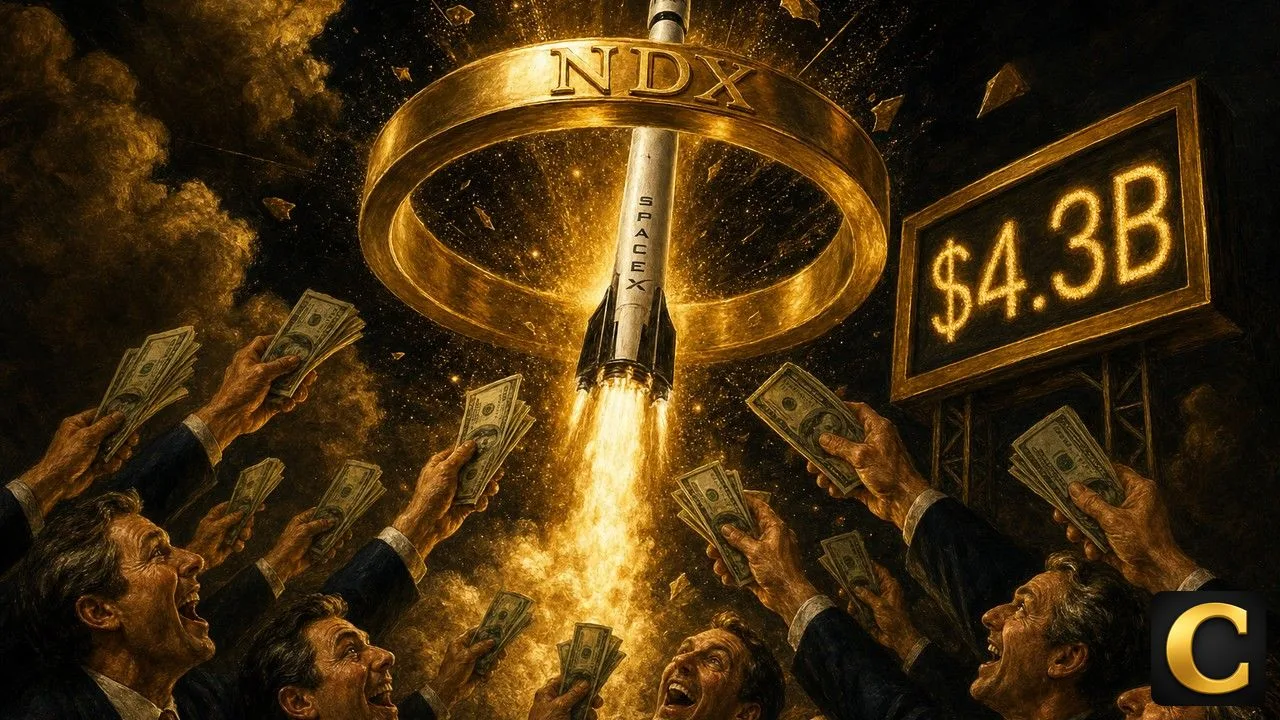
SpaceX joins the Nasdaq-100 on July 7, only 15 trading days after its June 12 IPO, making it the fastest index inclusion in the benchmark’s history. The addition triggers roughly $4.3B in mechanical buying from index funds, according to a JPMorgan estimate, with much of that flow expected after the close on July 6. SpaceX becomes the first company to benefit from the Nasdaq’s new “fast track” rule, designed for companies ranking among the 40 largest by market value. The Nasdaq-100 has more than $800B benchmarked against it via the Invesco QQQ Trust and thousands of retirement funds.
Key Takeaways
- SpaceX joins Nasdaq-100 on July 7, 15 trading days after its June 12 IPO, a benchmark record.
- JPMorgan estimates $4.3B in forced index buying, concentrated around the July 6 close.
- SpaceX is the first user of the Nasdaq’s “fast track” rule, built for 40-largest-by-market-cap firms.
The Fast Track Rule and Why It Exists
The 15-day timeline is unprecedented. Traditionally, a company needed to trade on the Nasdaq for months before qualifying for the Nasdaq-100. The “fast track” rule shortens that wait to 15 trading days for companies ranking among the 40 largest by market value on the exchange. SpaceX qualified immediately given its $2.1T valuation at IPO.
The rule change did not happen in a vacuum. Bankers lobbied hard for it, in part to make sure that large-cap listings would not sit outside the main passive-fund benchmark for extended periods. The economic rationale is simple: when a mega-cap trades outside the index, passive vehicles cannot own it, which creates an anomalous demand imbalance. The Nasdaq-100 wanted to close that gap.
SpaceX becoming the inaugural beneficiary is significant for two reasons. First, it validates that the rule works for its intended purpose. Second, it sets a precedent for the pipeline of upcoming IPOs that could follow the same path. Any future mega-cap listing that ranks in the top 40 by market value at IPO now has a clear 15-day path into the passive complex, which changes the calculus for both issuers and investors.
The context of SpaceX’s own IPO is important. The company priced its shares in the June 12 debut and saw the stock climb roughly 20% on the first day, as documented in the note on the $1.75T listing at $135 per share. That first-day pop was already partially anticipation of the Nasdaq-100 inclusion, so July 7 is the payoff phase of a trade that started three weeks ago. For context, see our earlier piece on CFinance: SpaceX Stock Jumps 19% on Wall Street Debut. The listing had already made history, SpaceX’s Nasdaq debut pricing at $135 for a $1.75T valuation.

The Mechanics of the $4.3B Forced Flow
JPMorgan’s $4.3B forced buying estimate is not a guess. It is derived from the assets under management of Nasdaq-100-linked passive vehicles multiplied by the target weight SpaceX will hold in the index at inclusion. The QQQ Trust alone runs several hundred billion dollars, and every 1% weight in the index represents billions in mechanical demand.
The flow is concentrated at the close on July 6. Index funds are required to hold benchmark weights, so when SpaceX joins the index at market open on July 7, funds must own their target allocation by that moment. The mechanical way to do that is to buy SPCX shares aggressively in the last hour of trading on the previous day, or in some cases via after-hours crossing sessions.
This concentrated flow historically creates a spike in trading volume and often a price bump around the inclusion moment. Sell-side desks have written extensively about the pattern, with most estimates suggesting a 2 to 5% pre-inclusion pop that partially reverses in the following days. In practice, the size of SpaceX’s $4.3B forced flow is large enough that the mark-up could be more pronounced.
The counterparty side of the trade is equally interesting. If passive funds must buy $4.3B worth of SPCX at the close, someone has to be selling. In practice, the sellers will be a mix of arbitrage desks that positioned early, insiders whose lock-ups have expired, and long-only funds trimming other Nasdaq-100 positions to fund the SpaceX allocation. Any large trim in existing components could add pressure on the chip complex that already suffered a rough Q2 close in semis.
The Bigger Picture on SpaceX Valuation
At $2.1T valuation, SpaceX trades at more than 100x sales. That multiple is stretched even by hyper-growth standards, and it invites scrutiny of the underlying business fundamentals. The current revenue mix breaks down as $11.4B from Starlink, with the remaining $6.6B from launches and AI infrastructure development.
Starlink’s dominant weight in revenue matters because it changes the SpaceX thesis. Instead of a pure-play launch company, SpaceX is now a satellite connectivity operator that also happens to have the world’s cheapest rocket business. The launch business has reduced its cost per kg by 85% since 2010, which is impressive engineering but does not command a 100x multiple on its own.
The AI infrastructure component is the newest thread and the least well understood by markets. SpaceX has been building compute clusters and satellite-based edge networks that some analysts frame as a direct challenge to hyperscaler roles. If that thesis materializes, the SpaceX story becomes an AI story with a rocket sidecar, rather than the other way around.
Historical precedent for Nasdaq-100 inclusions suggests caution. Recent additions have either seen minimal movement or declined within ten days of entry. The valuation setup here is stretched even by the standards documented in the trillion-dollar stocks comparison where SpaceX ranked as the priciest name. The initial pop from mechanical buying often gets absorbed as active managers rebalance out of the name once the index-driven flow subsides. Investors who chase the inclusion pop can find themselves holding a position that fades over the following two weeks.
For portfolio construction, the SpaceX inclusion also raises a concentration question. Adding a $2.1T mega-cap to the Nasdaq-100 further concentrates the index in a handful of names. Combined with Apple, Microsoft, Nvidia, Amazon and Alphabet, the top holdings will represent an even larger share of the benchmark. Any allocator using QQQ as a diversified tech proxy is now getting a highly concentrated bet, which conflicts with the diversification thesis. Bloomberg-style factor exposure has widened, and that is the underappreciated cost of the “fast track” rule that let SpaceX in so quickly.
More to come.
About the Author