
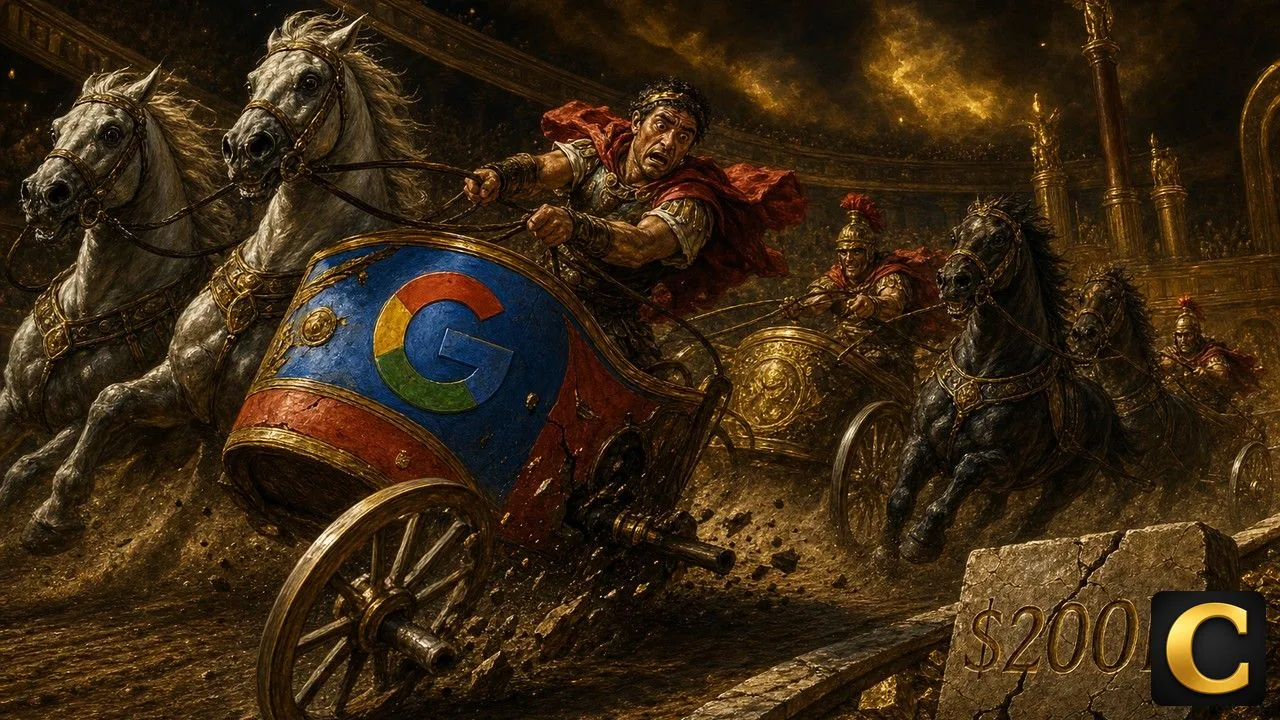
Alphabet stock fell 4.4% on Thursday, erasing about $200B in market value, after a report said Google is months behind on Gemini 3.5 Pro, its most powerful flagship AI model. The delay lands at a delicate moment, with rivals Anthropic and OpenAI shipping models that reportedly beat Gemini on enterprise benchmarks. Yet the same week carried a very different signal, with Warren Buffett confirmed as a $31B holder and a cloud business still compounding fast. Quarterly results due July 22 will test which narrative wins. This article covers the single-day wipeout, why a model slip reprices the whole stock, the bull case underneath the drop, and the risks that can widen the gap.
The Read
- Alphabet stock dropped 4.4%, cutting roughly $200B from market value
- Gemini 3.5 Pro is reportedly months late as rivals gain on enterprise benchmarks
- Q2 results on July 22 will test a cloud engine growing 63% against the AI-race bill
A $200B Single-Day Wipeout on a Delay Report
The tape moved first and asked questions later. Alphabet stock closed down 4.4% near $353, wiping out about $200B in market value in a single session. The trigger was a report that Google is months behind schedule on delivering Gemini 3.5 Pro.
The delay stems from Google taking extra time to improve the model, particularly in coding, after recent training runs delivered disappointing results. The company framed it as quality over speed, with a spokesperson pointing to a wide range of models shipped while staying cost-effective for customers.
The market read it differently. A flagship slip at the top of the lineup is the kind of headline that concentrates positioning risk fast, especially in a name that had rallied into the print. The move erased most of the recent gains in one afternoon.

Why a Model Slip Reprices the Whole Stock
A delayed model is not just a product footnote. It feeds directly into the enterprise-AI thesis that carries a large slice of Alphabet’s forward valuation. If Gemini falls behind on enterprise benchmarks against Anthropic and OpenAI, the risk is lost share in the exact market investors are paying up for.
The talent signal made it worse. Reports flagged that five senior Google AI figures left within seven days, a cluster of exits that reads as internal friction rather than routine churn. Markets treat departures around a flagship miss as a leading indicator, not a lagging one.
There is a structural drag too. Google runs multiple layers of stakeholders before a model ships and has to integrate it across Search, Maps and YouTube, which slows release cycles. The bull read is that this same integration is a moat once the model lands. The bear read is that it keeps Google a step behind faster, narrower rivals, the same enterprise-AI race that has Microsoft putting 6,000 engineers on its Frontier AI push. That tension is the whole debate in one stock.
Buffett’s $31B Bet and a Cloud Engine Compounding at 63%
The drop hides a strong fundamental base. Warren Buffett confirmed building a $31B Alphabet position, now second only to Apple among Berkshire’s holdings, a signal that a long-horizon buyer sees value at these levels. Endorsements like that rarely coincide with a broken thesis.
The cloud number is the other pillar. Google Cloud expanded 63% last quarter to nearly $20B, the high-growth layer that reframes Alphabet as more than a search-ad machine. That business is where the AI investment is supposed to convert into recurring revenue.
Earnings momentum backs the setup. Wall Street expects Q2 EPS near $2.86, up about 24% year over year, when Alphabet reports on July 22. A capital plan of $180-190B on AI infrastructure signals conviction that the demand wave is real, the same wave feeding the AI spending boom Nvidia expects to run through 2030. If the print confirms the trajectory, the Gemini delay looks like a timing issue, not a thesis break.
An EU Order and an $80B Capital Bill
The bear case is not only about a late model. The European Commission ordered Google to open Android features and share Search data with competitors, with implementation set for 2027. That reshapes the moat investors lean on and lands while the company is already on the back foot.
The capital math is the sharper risk. Buffett himself acknowledged the AI spending race is real money, and the intensity has forced a reversal of the buyback strategy and an $80B equity raise to fund the build. That is the same capex trap now shadowing every megacap, and it turns a balance-sheet strength into a question mark almost overnight.
The other side of this is positioning. Alphabet had run with the megacap complex, the same tape that lifted Meta stock 15% in its best week since early 2024, so a crowded name unwinds fast on bad news. The asymmetry to price: the fundamentals argue the drop is an overreaction, the AI-race clock argues every quarter of delay costs share. July 22 is where the two meet.
More to come.
About the Author