
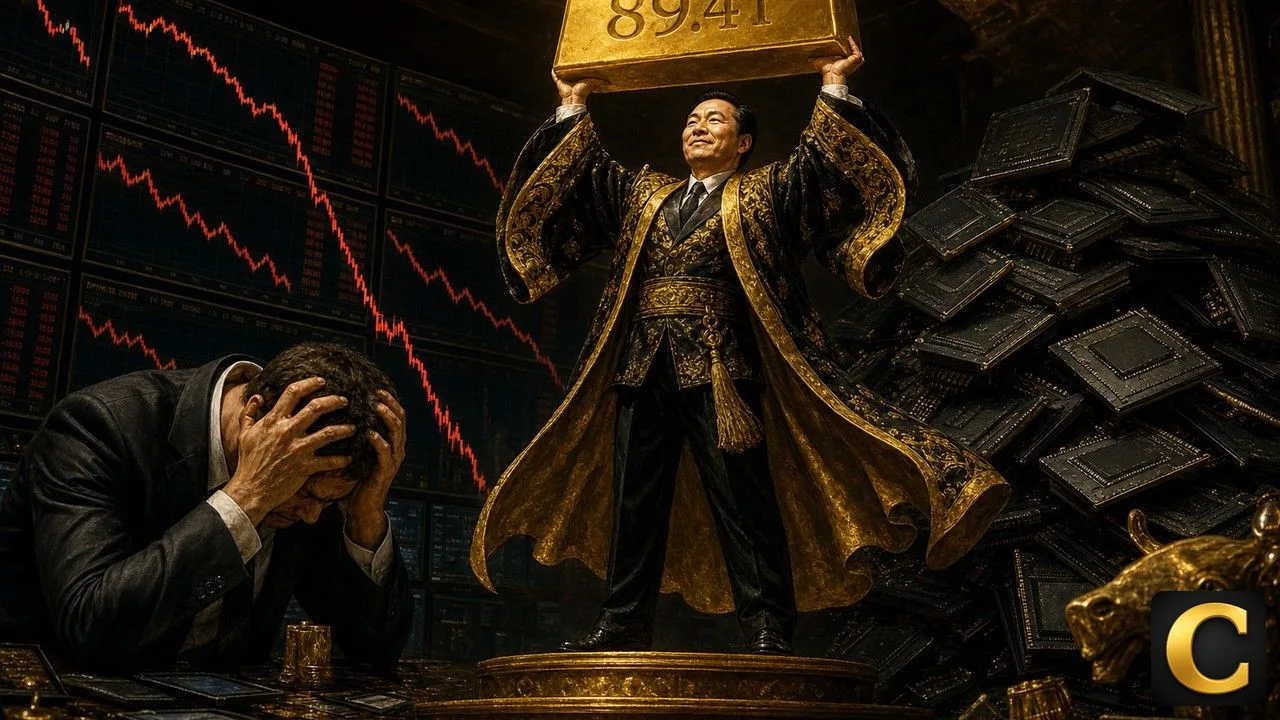
Samsung Electronics posted preliminary Q2 2026 operating profit of 89.4 trillion won, up more than 1,810% year-on-year and well above the 84.2 trillion won analyst consensus. The result marks the largest quarterly profit ever booked by the world’s biggest memory chipmaker. Yet the stock closed nearly 7% lower Tuesday and touched down to 11% intraday, as classic sell-the-news mechanics kicked in after months of memory price rally. Memory peers followed sharply, with Kioxia dropping 12% and SK Hynix, Micron and Sandisk drifting lower overnight. The market read the print as a peak signal on AI capex, not a growth stepping stone. This article unpacks the numbers, the sell-off logic, and what the setup means for memory positioning into H2 2026.
Key Takeaways
- Samsung Q2 profit hits 89.4 trillion won, up 1,810% YoY, above the 84.2 trillion won consensus.
- The stock closed 7% lower and touched 11% down intraday, on sell-the-news dynamics and AI capex peak fears.
- Memory peers slid in sympathy, with Kioxia off 12% and SK Hynix, Micron and Sandisk under pressure.
The Q2 print itself: a record ripped from the AI memory rally
Samsung Electronics reported preliminary Q2 2026 operating profit of 89.4 trillion won, roughly $58 billion at current FX, up more than 1,810% from the 4.68 trillion won posted a year earlier. The company’s own preliminary release confirms the beat and cements the print as the largest quarterly profit in the group’s history.
The beat vs the 84.2 trillion won street consensus is not trivial. In relative terms, Samsung outperformed the average sell-side estimate by more than 6%, an unusually clean top-line surprise for a company that guides tightly on preliminary numbers.
The core driver is memory pricing. DRAM, high-bandwidth memory (HBM) and NAND flash prices all traded sharply higher during the quarter on unrelenting AI accelerator demand. Samsung captured most of that pricing power thanks to its dominant global share on each of the three memory sub-segments.
Peer positioning tells a coherent story. SK Hynix, Micron and the memory value chain as a whole ran through a similar quarter of pricing tailwinds. Samsung’s magnitude, on top of that, reflects the sheer size advantage of the group when the memory cycle turns constructive.

Market reaction and mechanics: sell-the-news, not a fundamental doubt
The stock did not follow the fundamentals. Samsung shares closed nearly 7% lower on Tuesday in Seoul, with the intraday move touching down as much as 11% in the first minutes of trading. The overnight overhang was already visible in adjacent memory names before European and US opens.
The disconnect is textbook sell-the-news mechanics. Sell-side desks flag that the memory upside had already been priced into the stock through the run-up of the past three months. The rally into the print left the setup asymmetric, with the beat looked for but the “how much beat” the only variable that could actually move the stock.
Some aggressive buy-side estimates were reportedly running above the 89.4 trillion won mark. Against those numbers, the beat vs consensus reads as an in-line print, or even a mild miss on the whisper number. That gap between headline beat and whisper miss is what typically triggers this class of profit-taking wave.
The other angle sitting behind the tape is the broader question of AI capex sustainability. The market is starting to weigh how long hyperscalers can keep buying at current prices, and whether current memory pricing represents a cycle peak rather than a new baseline.
Short-term consequences: memory sector under contagion
The immediate spillover was sharp on memory names. Kioxia dropped 12% in Tokyo, catching the full weight of the sell-off. SK Hynix, Micron and Sandisk drifted lower overnight, all echoing the same “capex peak” concern that hit Samsung.
The read across for the semi cycle is more mixed. AI chip stocks had already been under pressure the previous session, with the broader semi complex down 5% while the Dow set a fresh record. The Samsung print reinforced that split between benchmark strength and semi weakness on the day.
Investors positioning around the Q2 earnings season now need to reset expectations on the memory-adjacent names. Fabricators, wafer suppliers and back-end vendors that had priced in a continuation of the memory rally into H2 2026 face a fresh round of scrutiny on their multiples.
For active books, the short-term takeaway is straightforward. Trim positioning where the exposure to memory pricing was the whole thesis, hold names where the AI angle is broader than pure memory, and keep an eye on the read-through into ASML, Applied Materials and Lam Research at their Q2 prints. Applied Materials was already down 10% earlier in the week on a related capex signal.
Medium-term outlook: is this the memory cycle peak?
The medium-term question is whether Q2 2026 marks the peak of the memory cycle or a step in a longer plateau. Bull cases still lean on the AI capex trajectory. Bear cases point at hyperscaler capex normalization once the current fleet deployment is booked.
Historical memory cycles suggest 12 to 18 months of pricing tailwind followed by a rapid retracement once supply catches up. If that template plays out here, the current pricing environment could stay constructive well into H1 2027 before rolling over.
The other reading is that AI accelerators structurally shift the memory demand curve, effectively resetting the baseline higher. That view is consistent with the projections around AI capex trajectories laid out earlier this month, notably Nvidia’s $3-4T AI spending forecast by 2030, which reframes memory as a structurally undersupplied resource.
For an investor positioning through H2 2026, the immediate call is more about position sizing than direction. Samsung remains a dominant memory franchise. The sell-off says more about entry multiples and near-term expectations than about the long-run cash flow of the group.
The next major markers to watch are the SK Hynix and Micron prints, the ASML order book, and any commentary from hyperscalers on capex allocation in H2. Each will either validate the peak thesis or push it out further into 2027.
More to come.
About the Author