
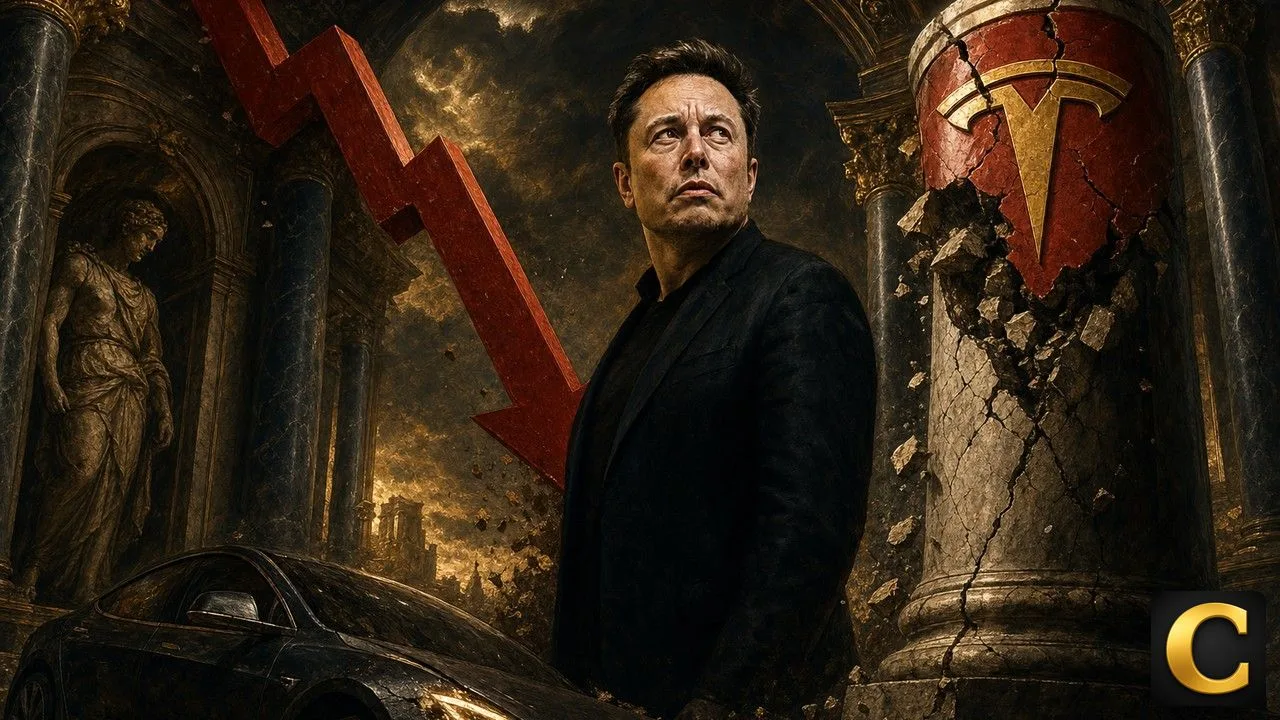
Tesla opened Big Tech earnings week on the wrong foot, and the tape did not forgive it. The stock closed at $320.21, down 14.38%, a loss of $53.80 in a single session that dragged it to an eleven-month low. The top line actually did its job, with revenue gains close to matching a 25% year-over-year jump in deliveries, but profits dropped and free cash flow turned negative as operating expenses and capital spending soared. The number that broke the read was the operating margin, which collapsed to 1.4% as the company front-loaded AI and robotics investment. CEO Elon Musk called 2026 a massive capex year, guiding spending above $25 billion with no clear timeline for a return. This piece walks through the print, the margin mechanics, the bull case still resting on volume, and the bear case now written in cash burn.
The Read
- Tesla closed at $320.21, down 14.38%, an eleven-month low on a $53.80 one-day drop.
- Deliveries rose 25% year over year, but the operating margin fell to 1.4% and free cash flow went negative.
- Musk guided capex above $25B for 2026, and analysts cut price targets on margin pressure and cautious autonomy guidance.
Tesla Falls 14% After a Profit Miss and a Capex Shock
The session was brutal and it was heavy. Tesla shares fell to $320.21, down 14.38%, on volume of 114.2 million shares, some 131% above the three-month average. That is not a drift lower, it is a repricing, and it dragged the stock to its lowest level in eleven months.
The quarter itself was not a demand story gone wrong. Revenue gains came close to matching a 25% year-over-year jump in deliveries, so the top line held. What broke was the bottom line, where profits dropped and free cash flow turned negative as operating expenses and capital spending both soared.
The tape did not treat Tesla in isolation. The S&P 500 fell 1.21% to 7,408.30 and the Nasdaq Composite dropped 2.15% to 25,138, part of the same investor unease over AI spending that hit the group the day Big Tech earnings landed with AI spending squarely in focus. EV peers followed, with Rivian off 4.19% and Lucid down 4.87%.
Analysts moved fast. Several lowered their price targets for Tesla after the miss, pointing to margin pressure and cautious guidance on autonomous driving. The message from the sell-side was that the growth is real but the return on the spending is not yet visible.

A 1.4% Operating Margin Is Where the Damage Shows
The single figure that carried the selloff was the margin. Tesla’s operating margin fell to 1.4%, a level that leaves almost no cushion between revenue and cost, as heavy AI and robotics investment pushed the expense base higher. When a growth company posts volume gains and a margin like that, the market reads it as spending running ahead of returns.
The mechanics rhyme with the rest of the sector. Alphabet lifted its own capital budget to as much as $205 billion for the year, and the market punished it too, the same reflex that hit shares the day Alphabet shed $200B on a Gemini delay. Capex without a clear payback window is the fault line running under every megacap right now.
Free cash flow is the tell. A quarter where free cash flow turns negative while deliveries grow means the growth is being bought, not earned, and the buyer is the balance sheet. That is sustainable only as long as investors believe the autonomy and robotics bet converts, which is exactly the belief the print put under pressure.
25% Delivery Growth Keeps the Volume Bull Case Alive
The bull case did not disappear, it got cheaper. Deliveries still grew 25% year over year, which means the core vehicle business is taking share even as the stock derates. If the spending Musk defends as a massive capex year lands, the same investment crushing the margin today becomes the moat tomorrow.
There is an optionality argument the bears cannot fully dismiss. The AI and robotics program is a call option on autonomy, and the market pays for that option when spending shows a return, in the same way it rewarded the capex thesis when Nvidia framed AI spending running toward $3 to $4 trillion by 2030. Tesla sits on the demand side of that build-out.
Positioning also matters after a drop this size. A 14.38% single-day loss on volume 131% above average clears a lot of weak hands, and a stock that survives a capitulation like that often finds systematic buyers on any guidance upgrade. The bull case needs one clean quarter where margin stabilizes and the capex line flattens.
Negative Free Cash Flow Is the Bear’s Strongest Card
The bear case has the cleaner arithmetic. A company guiding capex above $25 billion for 2026 while running a 1.4% operating margin and negative free cash flow is spending into a return it cannot yet prove. Every quarter that pattern repeats, the market reprices the multiple lower, not higher.
The autonomy timeline is the soft spot. Analysts cut targets specifically on cautious guidance for autonomous driving, and if that catalyst keeps slipping, the spending loses its justification. When the catalyst that funds the capex keeps sliding, a beat elsewhere is not enough to hold the stock.
The asymmetry investors now have to price is stark. On one side, 25% delivery growth and an autonomy option that pays off if the capex converts. On the other, a 1.4% margin, negative cash flow and a spending guide that only works if a still-unproven catalyst arrives on time. The print did not settle the debate. It just moved the burden of proof firmly onto the next quarter.
More to come.
About the Author