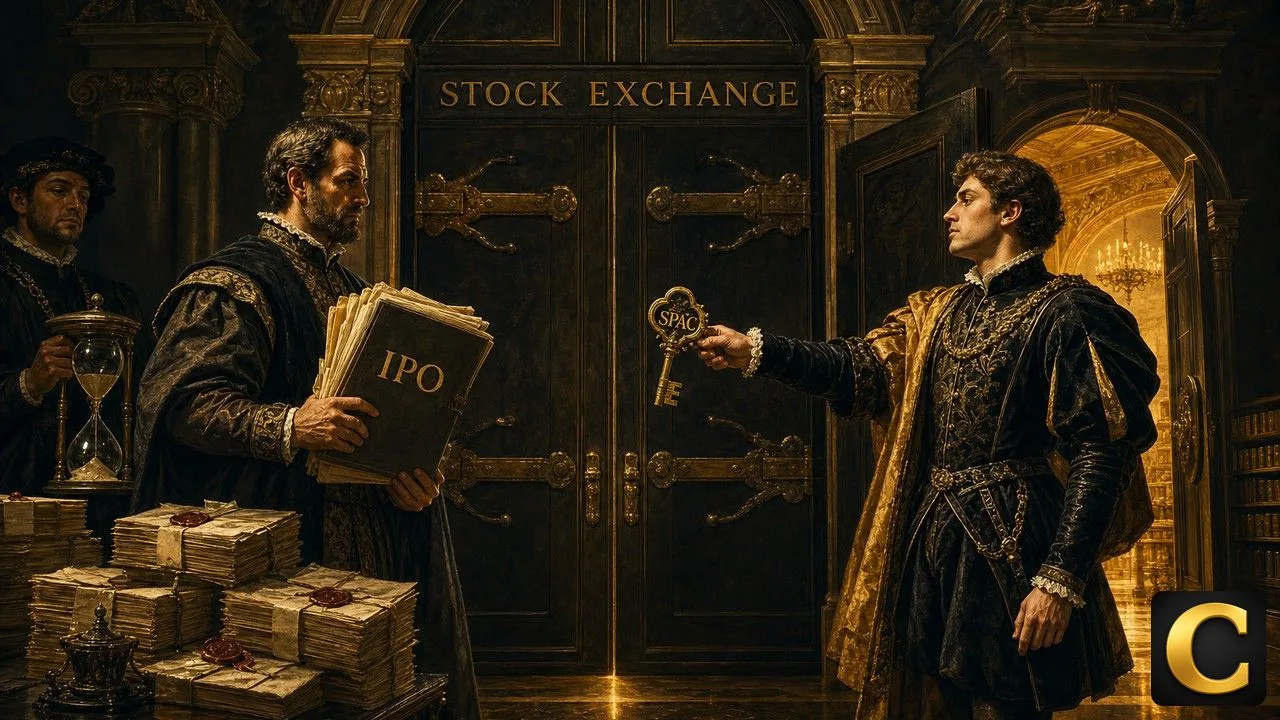
IPO and SPAC are both routes to public markets, but they carry very different mechanics, different cost structures, and very different implications for retail investors. Over the last five years, both paths have been used aggressively by very different types of companies, sometimes for the same underlying reason (speed to market), often for opposing reasons (regulatory scrutiny, price certainty). This guide walks through what each path actually does, how it works step by step, what the real cost difference looks like on a live deal, and which type of company tends to pick which route. The frame stays practical, not academic. The examples are real: Airbnb, Coinbase, DraftKings, Trump Media, and a handful more that made 2020 to 2025 the busiest window for both formats. The goal is to leave the reader able to price the difference at a glance.
The Read
- IPO takes 6 to 12 months and costs 4% to 7% of raised proceeds in bank fees.
- SPAC takes 3 to 6 months for the target and dilutes 20% to 30% of the equity to the sponsor.
- IPO fits mature companies with strong financials; SPAC fits pre-revenue or growth-stage companies with credible projections.
What an IPO actually is and who it is built for
An Initial Public Offering is the traditional way a private company transitions to public markets. The company files a Form S-1 with the Securities and Exchange Commission, engages one or more investment banks as underwriters, and eventually offers new shares to institutional investors during a roadshow before listing them on a public exchange (NYSE, Nasdaq, or another regulated venue).
The S-1 is the load-bearing document. It includes three years of audited financial statements, a discussion of risk factors, a description of the business, information about the management team, and a use-of-proceeds section. Every fact in the S-1 is subject to SEC review and can be flagged during the comment period. That review runs three to six months on its own, and the total process from decision-to-IPO to actual listing day typically stretches to 6 to 12 months. Companies that already trade in secondary private markets may compress the calendar, but they cannot skip the SEC review.
The pricing mechanic is where IPOs earn their reputation for uncertainty. During the roadshow, banks build a demand book across institutional investors (mutual funds, hedge funds, pension funds, sovereign wealth funds). The final IPO price is set the evening before listing, based on that book. If demand comes in stronger than expected, the price is raised; if weaker, cut. Retail investors do not participate in this book directly. They can only buy on the open market once the stock starts trading, often at a premium to the IPO price if the deal is hot.
So the IPO tax is transparent but heavy. Banks charge 4% to 7% of gross proceeds in underwriting fees, plus another 1% to 2% for legal, accounting, and printing costs. For a $500M raise, that is $25M to $45M paid out of the company’s proceeds before it ever hits the balance sheet. IPOs suit mature companies with strong financials, clean operating history, and enough institutional demand to fill a book. Airbnb, Coinbase (via direct listing, a variant), Snowflake all fit that profile.

How SPACs turn a blank check into a public listing
A Special Purpose Acquisition Company works in reverse. A sponsor (usually a private equity fund, hedge fund, or notable investor) creates a shell company that has no operations. The shell IPOs itself, typically at $10 per share, and raises capital from public investors on the promise of finding and acquiring a real business within two years.
Here is why the SPAC path took off. Once the sponsor identifies a target private company, the two negotiate a merger. Announcement goes public, shareholders of the SPAC vote to approve the deal, and if approved, the target company becomes public overnight by merging into the shell. That entire process from target announcement to closed merger runs 3 to 6 months, notably faster than an IPO. If the sponsor cannot find a target within the 2-year window, the SPAC is dissolved and shareholders get their $10 per share back plus interest, since the raised capital sits in a trust during the search.
The cost structure is where SPACs diverge sharply from IPOs. The sponsor gets a promote, usually 20% of the post-merger equity for a nominal contribution of $25,000. That is called founder shares or “sponsor promote”. Additionally, SPAC shareholders can redeem their shares before the merger vote and get their $10 back, which means the merged company often lands with less cash than initially advertised. Between the founder shares dilution and redemptions, the effective cost to the target company routinely lands in the 20% to 30% range, dramatically higher than the 4% to 7% of a traditional IPO.
The other side of this is regulatory. A merger with a SPAC has historically required a proxy statement (Form S-4) rather than an S-1, and the disclosure standards were looser. In particular, target companies could publish forward-looking revenue projections during the merger, something the S-1 process makes practically impossible. That flexibility made SPACs attractive to pre-revenue growth companies (electric vehicles, space, biotech, retail brokers) whose story rested on projections rather than trailing financials. The SEC tightened those rules in 2024, closing part of the disclosure gap, but the fundamental faster-cheaper-for-projections trade-off remains.
Airbnb, Coinbase, DraftKings, Lucid: what the numbers show
Airbnb went public via traditional IPO on December 10, 2020. The company priced shares at $68, opened at $146, and closed the first day at $144. That “IPO pop” left roughly $4B on the table (the difference between what the company raised and what public investors paid on day one). Institutional allocation captured that upside; retail investors buying on day one paid full open-market prices. Airbnb’s S-1 disclosed profitable Q3 2020, three years of audited financials, and clear unit economics.
Coinbase went public via a direct listing on April 14, 2021 (a variant of the IPO where no new shares are issued and existing shareholders sell directly to the market). The reference price was $250, the stock opened at $381, and eventually settled around $328. No underwriting fee applied because no new capital was raised, but Coinbase paid roughly $52M in advisory fees. Direct listings work only for companies with strong brand recognition and enough natural demand to skip the book-building process.
DraftKings took the SPAC route. It merged with Diamond Eagle Acquisition Corp in April 2020. The combined entity started trading at around $19 per share, well above the $10 SPAC IPO price. DraftKings was still burning cash at the time (adjusted EBITDA loss of $142M in 2019), which would have complicated a traditional IPO but fit the SPAC template. The company grew market cap from roughly $3B post-merger to $23B by early 2021, though sponsor and PIPE dilution meant existing DraftKings shareholders owned significantly less of the combined company than a straight IPO would have delivered.
Lucid Motors merged with Churchill Capital Corp IV in July 2021 in what remains one of the largest SPAC deals ever, valued at $24B at close. Lucid used the SPAC path specifically to raise growth capital while trading on future EV production projections it could not have used in a traditional S-1. The stock traded near $50 at close and later collapsed to below $10 as production ramps missed the projections. That trajectory captures the double-edged nature of SPAC merger economics: fast path to capital, aggressive projections, later reckoning when execution lags. Recent examples include SpaceX trading below its IPO price after Nasdaq 100 entry, and OpenAI delaying its own IPO to 2027 after that SpaceX drop, which shows how the framework recalibrates in a lower-tolerance market.
Which format fits which company, and where retail should watch
The decision framework compresses to three variables: financial maturity, growth-story credibility, and speed urgency. A company with three years of audited profitable financials and predictable unit economics almost always picks the traditional IPO route. It gets the cheapest capital, the deepest institutional book, and the most favorable trading dynamics post-listing. Airbnb, Snowflake, and most mature tech IPOs of 2020 to 2022 fit that template.
A pre-revenue or high-burn company with a compelling growth story picks the SPAC route when it exists. The 2024 SEC tightening cut some of that flexibility, but pre-revenue biotech, electric vehicles, and space companies still find SPACs the only viable path for a story that leans on 3 to 5-year projections. The dilution cost is high, but the alternative is often no public listing at all.
Now the retail lens. Retail investors buying at IPO price on a traditional IPO almost never get an allocation. They buy at the open, at the “pop” price, and are the marginal buyer setting the trading benchmark. In SPAC deals, retail can buy the SPAC at $10 during the search period and choose to redeem before the merger vote if the announced target is unappealing. That optionality is worth measuring: it means a SPAC purchase at $10 is essentially a call option with $10 downside protection until the merger vote. SpaceX’s Nasdaq-100 forced buying dynamic illustrates how post-listing mechanics can move both IPO and SPAC-listed stocks in ways unrelated to fundamentals.
One thing to notice is how the two markets rebalance across cycles. In 2021, there were 613 SPAC IPOs in the United States alone, a record. By 2023, the count had collapsed to 32 as regulatory tightening, dilution scrutiny, and post-merger underperformance reduced sponsor appetite. In 2024 and 2025, SPAC activity picked up again but with more selective sponsors and higher-quality targets. Traditional IPOs meanwhile ran counter-cyclical, with 2024 to 2025 producing some of the largest listings ever (SpaceX, Klarna, Rubrik among them). Retail investors should read that cycle: when SPAC counts collapse, discipline is returning; when they spike, sponsor incentives are running ahead of investor economics.
The final read. IPO and SPAC are tools, not verdicts on the company. A great business can pick either path for the right reasons. A weak business often reveals itself by picking the path with the loosest disclosure and the fastest closing calendar. Reading the choice of path is a signal in itself, before reading any single line in the prospectus.
More to come.
About the Author